Commercial Banking Case Study Interview: Worked UK Credit Case & Model Answer
Work through a realistic commercial banking case study: a fictional UK manufacturer wants £6m to fund an acquisition. Read the case pack, answer the task against a 35-minute clock, decide whether you'd lend, then mark your answer against a full model recommendation.
Start the caseInterview already booked? The interview course has three more cases like this one →
Suitable for commercial and corporate banking applications
- Graduate schemes
- Analyst roles
- Internships and placements
- Relationship manager interviews
- Credit analyst assessments
Applying to one of these banks? Our guide to each bank's process is a click away. FinancePathway is independent and not affiliated with any bank.
Commercial banking case study: would you lend Alderstone £6m?
Work through this commercial banking case study in three stages, as you would on the day: read the case pack, answer the task against the clock, then mark your answer against the model.
Alderstone Components Ltd
Fictional UK manufacturer · £38m revenue · 18 years trading
- Six-year term loan
- £6.0m
- To buy Harland Precision
- £8.0m
- Time allowed
- 35 min
- Pre-readingThe case pack · 10 min
- Your taskThe questions · 25 min
- Model answerYour answer, marked
The clock starts when you open the case.
Prefer to work on paper?
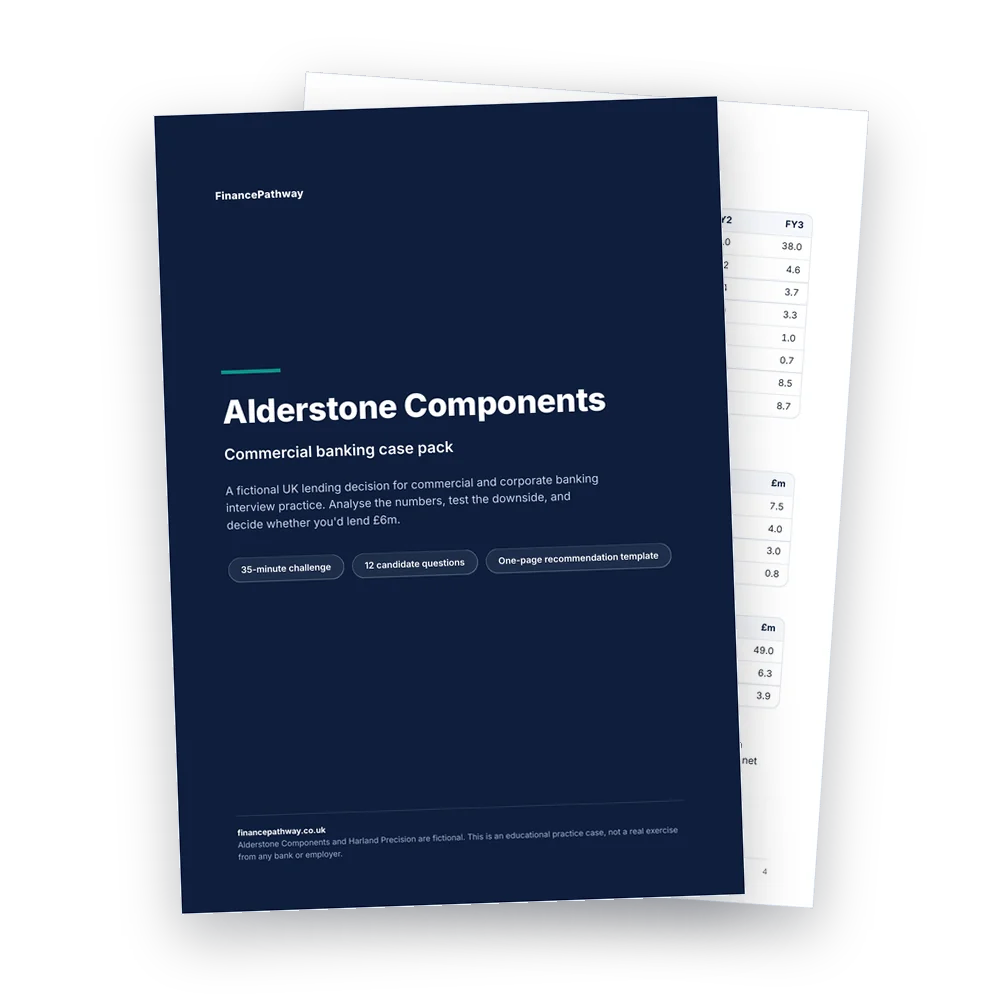
Get the Alderstone case pack: this commercial banking case study as a printable PDF, with a one-page recommendation template, plus an Excel workbook with every figure.
Email sign-up isn't available at the moment. You can still work through the case on this page.
Admin note (only visible when logged in): add the Hostinger Reach widget with the CSS class fp-casepack-form below this HTML widget.
Stage 1: Pre-reading
Read the case pack as you would before the interview, and make notes as you go: you'll need these figures in Stage 2. Allow about 10 minutes.
The borrower
Alderstone Components Ltd manufactures and distributes precision metal components for industrial equipment, transport and energy infrastructure. It has traded for 18 years, employs 160 people across two Midlands sites, and turned over £38m in its latest financial year (FY3).
Its largest customer accounts for 25% of FY3 revenue. The relationship goes back nine years and runs on a rolling framework agreement with no guaranteed minimum volume, terminable on 90 days' notice.
The acquisition
Alderstone has agreed to buy Harland Precision Ltd for £8.0m. It will fund £2.0m from its own cash and is asking the bank for the remaining £6.0m. Management expects £0.3m a year of synergies, available in full from year one. These haven't been independently verified.
| Harland Precision, last 12 months | £m |
|---|---|
| Revenue | 9.0 |
| EBITDA | 1.2 |
| EBIT | 0.95 |
| Cash from operations | 0.85 |
| Maintenance capex | 0.25 |
The request
A £6.0m six-year amortising term loan, repaid at £1.0m a year, with illustrative first-year interest of £0.45m.
Alderstone's historical performance
| £m | FY1 | FY2 | FY3 |
|---|---|---|---|
| Revenue | 31.0 | 34.0 | 38.0 |
| EBITDA | 3.7 | 4.2 | 4.6 |
| EBIT | 3.0 | 3.4 | 3.7 |
| Cash from operations | 2.7 | 3.0 | 3.3 |
| Capex | 0.8 | 0.9 | 1.0 |
| Cash interest | 0.5 | 0.6 | 0.7 |
| Net debt | 7.0 | 7.8 | 8.5 |
| Operating working capital | 5.7 | 6.9 | 8.7 |
Debtor days rose from about 60 to 73 over the period.
Existing debt, before the acquisition
| Facility | £m |
|---|---|
| Term debt | 7.5 |
| Revolving credit facility: drawn (of £5.5m committed) | 4.0 |
| Cash | 3.0 |
| Existing scheduled principal repayments a year | 0.8 |
Management's forecast for the combined group (year one)
| Combined, year one | £m |
|---|---|
| Revenue | 49.0 |
| EBITDA (Alderstone 4.8 + Harland 1.2 + synergies 0.3) | 6.3 |
| Cash available for debt service | 3.9 |
Assumptions for the downside case
Assume EBITDA falls 20% below the combined historical figure, with no synergies, and cash available for debt service falls to £2.7m. Interest and scheduled principal stay the same, and net debt stays at its pro-forma level.
Stage 2: Your task
You're the graduate preparing this case for a credit discussion. Work through the twelve questions on paper, then fill in the answer sheet. You can go back to the pre-reading at any time. Allow about 25 minutes.
- What is the purpose of the loan, and what is the proposed source of repayment?
- What are the strongest features of Alderstone and the transaction?
- What are the main credit risks?
- How has historical financial performance developed?
- What does the working capital information tell you?
- Calculate current net debt to EBITDA.
- Calculate pro-forma net debt to EBITDA after the acquisition.
- Calculate existing and pro-forma interest cover.
- Calculate a simplified debt service coverage ratio (DSCR).
- Run the downside case.
- What additional information and protections would you require?
- Would you recommend that the bank provides the loan?
Stage 3: Model answer
Approve, decline or restructure? Check your marked ratios and your decision first, then read the full worked answer.
Purpose and source of repayment
The £6.0m funds most of the £8.0m Harland acquisition, with Alderstone contributing £2.0m of its own cash. The primary source of repayment is the combined group's operating cash flow. The secondary source is security over the group's assets and Harland's shares.
Strengths
- An established business. 18 years trading, with revenue up from £31.0m to £38.0m over two years.
- Stable profitability. EBITDA rose from £3.7m to £4.6m, a steady margin of around 12%.
- Consistent cash generation. Cash from operations grew from £2.7m to £3.3m.
- A profitable target. Harland makes £1.2m of EBITDA on £9.0m of revenue.
- Low starting leverage. 1.85x net debt to EBITDA and 6.57x interest cover before the deal.
Historical performance and working capital
Growth has been steady and margins stable, but net debt has still risen from £7.0m to £8.5m. Working capital explains much of that: it grew from £5.7m to £8.7m, from about 18% of revenue to about 23%, and debtor days lengthened from about 60 to 73. Growth is absorbing cash, which matters for a business about to take on more debt.
Leverage: net debt to EBITDA
Pro-forma net debt is £16.5m: gross debt of £17.5m (term debt £7.5m, revolver £4.0m, new loan £6.0m) less £1.0m of cash left after the £2.0m contribution. More on the ratio: net debt to EBITDA.
| Basis | Calculation | Result |
|---|---|---|
| Existing (FY3) | 8.5 / 4.6 | 1.85x |
| Pro-forma, no synergies | 16.5 / 5.8 | 2.84x |
| Pro-forma, with synergies | 16.5 / 6.1 | 2.70x |
| Management forecast EBITDA | 16.5 / 6.3 | 2.62x |
| Downside | 16.5 / 4.64 | 3.56x |
Interest cover
Pro-forma cash interest is £1.15m: the existing £0.7m plus £0.45m on the new loan. Cover stays comfortable even in the downside. More: interest coverage ratio.
| Basis | Calculation | Result |
|---|---|---|
| Existing | 4.6 / 0.7 | 6.57x |
| Pro-forma | 5.8 / 1.15 | 5.04x |
| Downside | 4.64 / 1.15 | 4.03x |
Debt service cover (simplified DSCR)
This is the real test. Annual debt service is £2.95m: interest of £1.15m plus scheduled principal of £1.8m (the existing £0.8m and the new £1.0m). More: debt service coverage ratio.
| Case | Cash for debt service | DSCR | Cash left after |
|---|---|---|---|
| Management case | £3.9m | 1.32x | £0.95m |
| Lender-adjusted | £3.6m | 1.22x | £0.65m |
| Downside | £2.7m | 0.92x | (£0.25m) |
On smaller screens, swipe across the table to see every column.
The downside case
EBITDA falls to £4.64m, about 20% below the combined historical £5.8m, with no synergies. Cash available for debt service drops to £2.7m, while interest (£1.15m) and principal (£1.8m) stay the same and net debt is held at £16.5m. The group can no longer cover its repayments from cash flow: DSCR falls to 0.92x, leverage rises to 3.56x, and the leverage and DSCR covenants below would both be breached.
Key risks and mitigants
| Risk, in priority order | Mitigant | Limitation |
|---|---|---|
| Acquisition and integration: the group isn't yet operating as one business | A detailed integration plan, retained Harland management, synergies recognised in stages | No acquisition track record |
| Downside debt service: DSCR below 1.0x | More equity, a smaller loan, prudent amortisation, covenants | A longer tenor extends the bank's exposure |
| Working capital absorption: receivables and stock growing faster than revenue | Aged receivables review, borrowing-base monitoring, tighter reporting | Monitoring doesn't create cash |
| Customer concentration: about 20% of combined revenue, no minimum volumes | Nine-year relationship, framework agreement, Harland's different customer base | No guaranteed volumes |
| Lower liquidity: only £1m of cash at completion, before transaction costs | Undrawn revolver headroom (£1.5m) | Headroom is thin if working capital keeps growing |
| Margin and input-cost pressure: raw material costs passed on with a delay | Pass-through clauses, purchasing synergies | The timing lag can still squeeze margins |
On smaller screens, swipe across the table to see every column.
Illustrative covenants
These thresholds are invented for the exercise. The point is to check headroom, not to memorise levels. More: financial covenants.
| Covenant | Level | Base case | Downside |
|---|---|---|---|
| Maximum net debt to EBITDA | 3.25x | 2.84x (0.41x headroom) | 3.56x, breach |
| Minimum interest cover | 3.50x | 5.04x (1.54x headroom) | 4.03x, passes |
| Minimum DSCR | 1.15x | 1.22x (0.07x headroom) | 0.92x, breach |
On smaller screens, swipe across the table to see every column.
Structure and conditions
- Amount and contribution. More fresh equity or a smaller facility.
- Term and repayments. Matched to sustainable cash generation, not to the request.
- Security. Over material group assets and Harland's shares, subject to legal and valuation work.
- Conditions before drawdown. Satisfactory due diligence, the equity contribution, acquisition documents, security in place, and no material adverse change.
- Covenants. Leverage and coverage tests with genuine headroom.
- Reporting. Monthly integration reporting at first, management accounts, compliance certificates, aged receivables and annual budgets.
- Restrictions. On dividends and further borrowing while leverage is elevated.
Information still needed
- Acquisition due diligence, including a quality-of-earnings review of Harland and its normal working capital.
- Customer evidence: contracts, volumes, profitability and credit quality, especially for the largest customer.
- An aged debtor report, overdues, disputes and post-year-end collections, plus stock ageing.
- An integrated monthly cash-flow forecast for the combined group, with a plan for each synergy.
- A full debt schedule (pricing, maturities, revolver expiry, leases), the capex split and the tax profile.
- Who owns integration, and plans for key people.
Recommendation: support in principle, but not approve the £6m unconditionally as presented
Take it forward as a conditional credit proposal. The business is sound and leverage is manageable, but debt service is thin and fails in a reasonable downside, so the structure has to change.
Decline or reduce the request if:
- Harland's earnings turn out to be overstated
- receivables are materially impaired
- the integration plan isn't credible
- the revised structure still can't service its debt in a reasonable downside.
What is a commercial banking case study interview?
A commercial banking case study interview gives you information about a business, usually its accounts, its plans and a request for funding, and asks whether the bank should lend. You'll typically review the case against the clock, reach a recommendation, then present it and answer questions on it.
Interviewers aren't looking for a single right answer. They want to see whether you can understand a business, judge whether it can repay, spot what could go wrong, and explain a clear decision. That mirrors how banks lend in practice: Santander UK's guide What we look for when we lend puts cash flow, borrowing levels and interest cover at the heart of its decisions.
A commercial banking case study works just as well as corporate banking practice, and it's good preparation for credit analyst interviews, which often ask for a written analysis of a business and its accounts.
How to present a commercial banking case study recommendation in 90 seconds
In the room, you won't read out a five-page analysis. Lead with your decision, then give the reasons, the main risk, how you'd protect the bank and what you still need. Here's Alderstone in about 90 seconds.
"My recommendation is to support this in principle, but not to approve the £6m as presented. I'd take it forward as a conditional proposal.
The strengths are real: revenue has grown from £31m to £38m in three years, EBITDA from £3.7m to £4.6m, and Harland is a profitable business. Pro-forma leverage of 2.84x and interest cover of about 5x are manageable.
The problem is debt service. On a lender-adjusted basis, DSCR is only 1.22x. In a downside where EBITDA falls 20% with no synergies, it drops to 0.92x: the group couldn't cover its repayments, and the leverage and DSCR covenants would both breach.
The biggest risk is integration, followed closely by customer concentration and working capital. The largest customer is about a fifth of combined revenue with no minimum volumes, and debtor days have risen from 60 to 73.
So I'd want more equity or a smaller loan, repayments matched to sustainable cash flow, security over the group's assets and Harland's shares, and covenants with genuine headroom.
Before credit committee, I'd need quality-of-earnings diligence on Harland, an aged debtor report and a monthly cash-flow forecast for the combined group. If Harland's earnings are overstated, or the revised structure still can't service its debt in a reasonable downside, I'd decline."
Five challenge questions to practise
Say your reply out loud before you open each one.
What if Harland's EBITDA turns out to be £0.9m, not £1.2m?
Combined EBITDA falls to about £5.5m and leverage rises to about 3.0x, close to the 3.25x covenant. That's why quality-of-earnings diligence is a condition.
Your largest customer gives 90 days' notice. What now?
It's about a fifth of combined revenue with no minimum volumes. Ask what margin it earns and how fast costs could flex. The loan may need to be smaller, or the deal may not work.
Why six years? Would you shorten or lengthen it?
A longer tenor lowers yearly repayments and helps a thin 1.22x DSCR, but keeps the bank exposed for longer. Match repayments to sustainable cash flow, not to the request.
Debtor days went from 60 to 73. Growth or warning sign?
Either customers are paying more slowly, or the mix has shifted to customers on longer terms. Working capital rose from £5.7m to £8.7m, absorbing cash. Ask for the aged debtor report.
What would make you decline outright?
Overstated Harland earnings, impaired receivables, no credible integration plan, or a revised structure that still can't service debt in a reasonable downside.
Explaining the decision to the client
As a relationship manager, you'd also have to explain this decision to Alderstone's finance director. Lead with what the bank can support, be clear about the conditions and why they matter, and offer options, such as more equity, a smaller loan or a different repayment profile, rather than a bare no.
A reusable commercial banking case study framework
Use the same order for any commercial or corporate banking case, whatever the business. The one-page recommendation template in the printable case pack follows it.
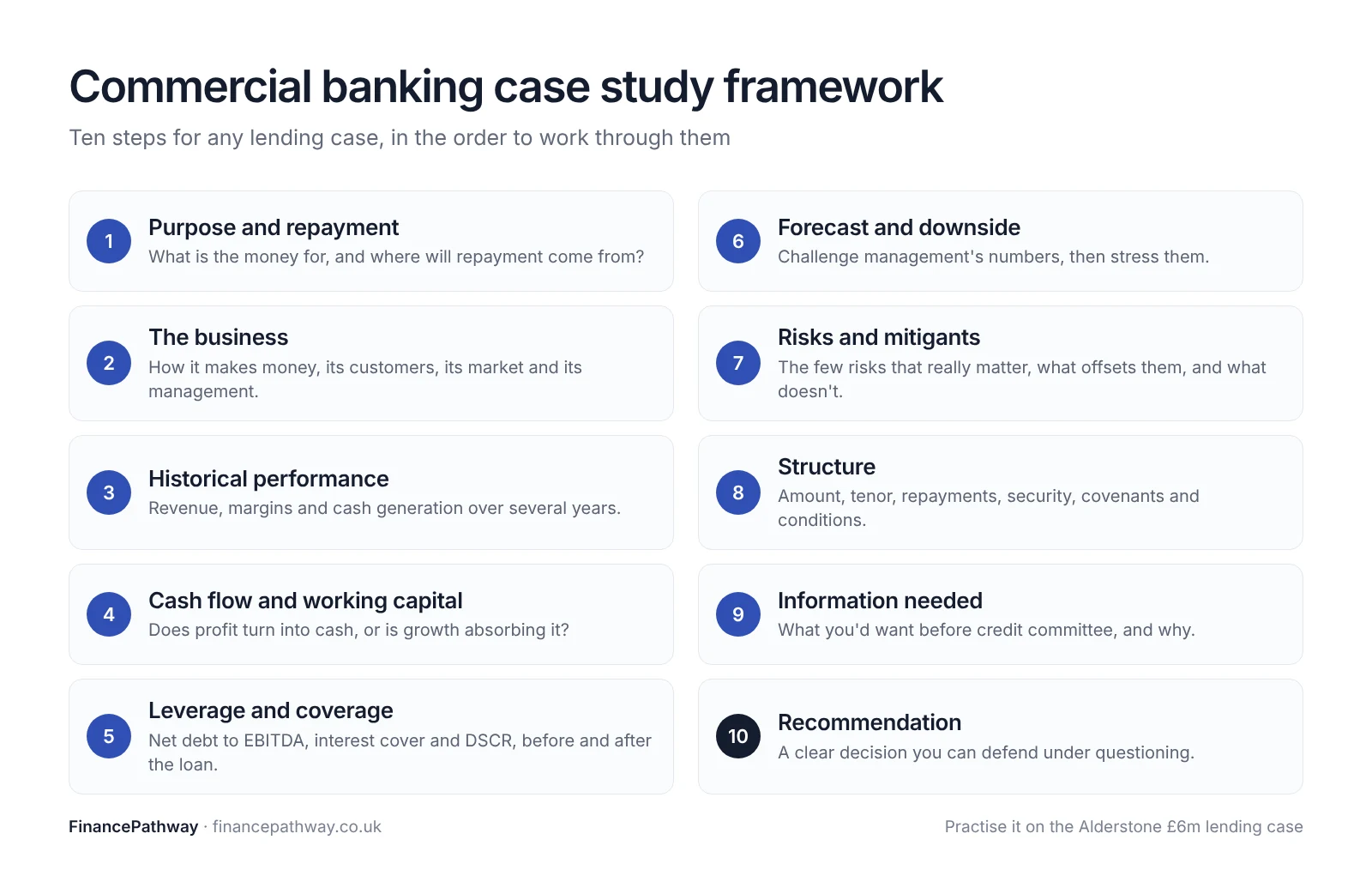
Purpose and repayment
What is the money for, and where will repayment come from?
The business
How it makes money, its customers, its market and its management.
Historical performance
Revenue, margins and cash generation over several years.
Cash flow and working capital
Does profit turn into cash, or is growth absorbing it?
Leverage and coverage
Net debt to EBITDA, interest cover and DSCR, before and after the loan.
Forecast and downside
Challenge management's numbers, then stress them.
Risks and mitigants
The few risks that really matter, what offsets them, and what doesn't.
Structure
Amount, tenor, repayments, security, covenants and conditions.
Information needed
What you'd want before credit committee, and why.
Recommendation
A clear decision you can defend under questioning.
Common commercial banking case study mistakes
- Starting with ratios. Understand the business and the purpose of the loan first. The numbers only mean something in that context.
- Treating EBITDA as cash. Working capital, capex, interest and tax all come out before the bank gets repaid.
- Taking the forecast at face value. Unverified synergies and optimistic growth should be stripped out or stressed.
- Skipping the downside. A loan that only works in the management case isn't a sound loan.
- A flat yes or no. Strong answers say on what terms: amount, structure, security, covenants and conditions.
- Listing risks without mitigants. Say what offsets each risk, and be honest about what doesn't.
- Burying the decision. Lead with your recommendation, then explain it.
Commercial vs corporate banking case studies: what changes?
The core judgement is the same in both: can this business repay the loan, what could stop it, and what would protect the bank if things go wrong. What changes is scale and complexity.
Commercial banking cases
Usually owner-managed or mid-sized businesses, a single bank relationship and straightforward facilities, such as this term loan.
Corporate banking cases
More often larger groups, several lenders, revolving credit facilities, and products such as hedging or trade finance alongside the loan.
If you're preparing for a corporate banking interview, Alderstone is still the right practice: the reasoning carries across. For the wider differences between the two roles, see corporate banking vs commercial banking, and for what the job involves day to day, TARGETjobs' corporate banker job description.
Preparing for a specific bank's assessment centre?
Assessment centre formats vary by bank, programme and year, and banks don't publish a standard lending case. For what each bank currently says about its process, see its guide.
Commercial banking case study FAQs
Common questions about commercial and corporate banking case study interviews.
Is a commercial banking case study the same as a corporate banking case study?
Mostly. Both ask whether a business can repay, what could go wrong and what would protect the bank. Corporate cases tend to involve bigger borrowers and more complex facilities. See corporate vs commercial banking.
What should I calculate in a commercial banking case study?
Leverage (net debt to EBITDA), interest cover and debt service cover, before and after the new loan, then the same again in a downside. The calculations matter less than what you say they mean for repayment.
How do I answer "Would you lend to this company?"
Lead with the decision, then the amount and structure, your three main reasons, the biggest risk and how you'd protect the bank, and what you'd still need to know. "Yes, with conditions" is often stronger than a flat yes or no.
Should I recommend covenants in a banking case study?
Yes, briefly: which ones, roughly where you'd set them, and how much headroom there is. In Alderstone, the debt service cover covenant has only 0.07x of headroom in the base case, exactly the kind of point interviewers pick up on. More on financial covenants.
How should I present my commercial banking case study recommendation?
Decision first, in about 90 seconds, then be ready to defend it. See the 90-second answer above.
What if there isn't enough information to make a lending decision?
Say what you'd need and why, and make your recommendation conditional on it. The model answer does exactly this.
Is there one correct answer to a commercial banking case study?
Usually not. Interviewers are testing how you reason and whether you can defend your view. A well-argued "decline" can beat a weak "approve".
Is this useful for credit analyst interviews?
Yes. Credit analyst cases often ask for a written analysis of a business and its accounts. Do the same analysis, then write it up on the one-page template in the case pack.
Do UK banks use case studies at assessment centres?
Banks use interviews and exercises to test analysis, judgement and communication, but formats vary by bank, programme and year, and banks don't publish a standard lending case. For what a specific bank does, see its guide.
Alderstone Components and Harland Precision are fictional. This is an educational practice case, not a real exercise from Lloyds, NatWest, HSBC, Barclays, Santander or any other employer. Assessment formats vary by bank, programme and year. FinancePathway is an independent careers resource and is not affiliated with or endorsed by any bank.
You've worked one case. Here's what the full interview course looks like.
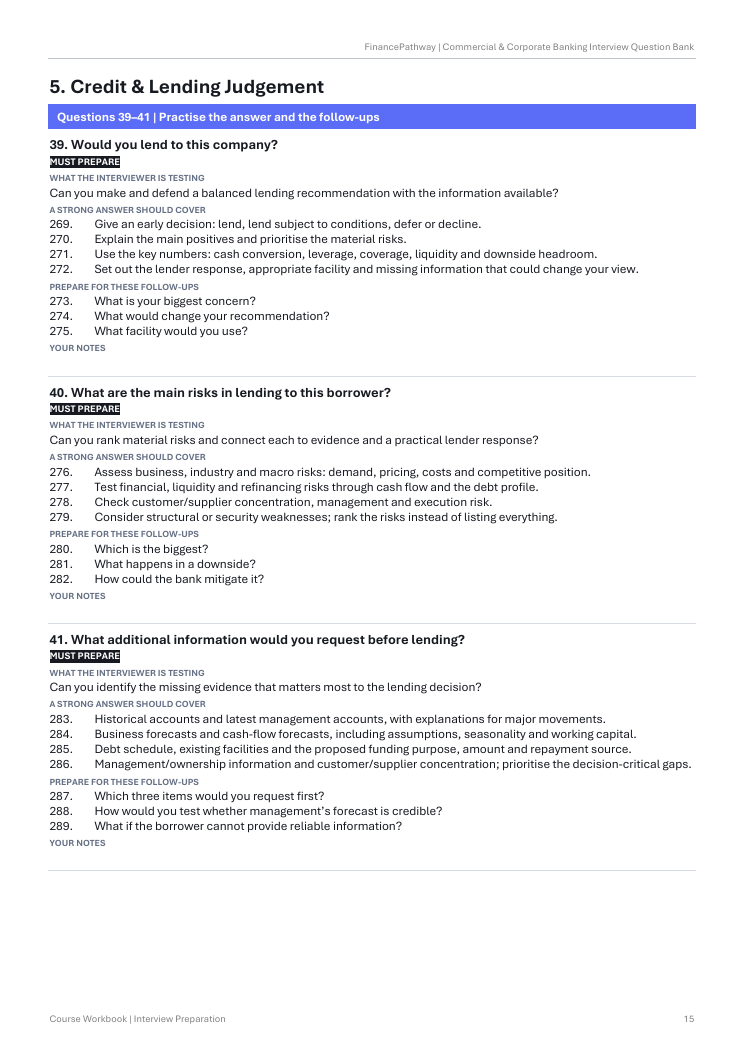
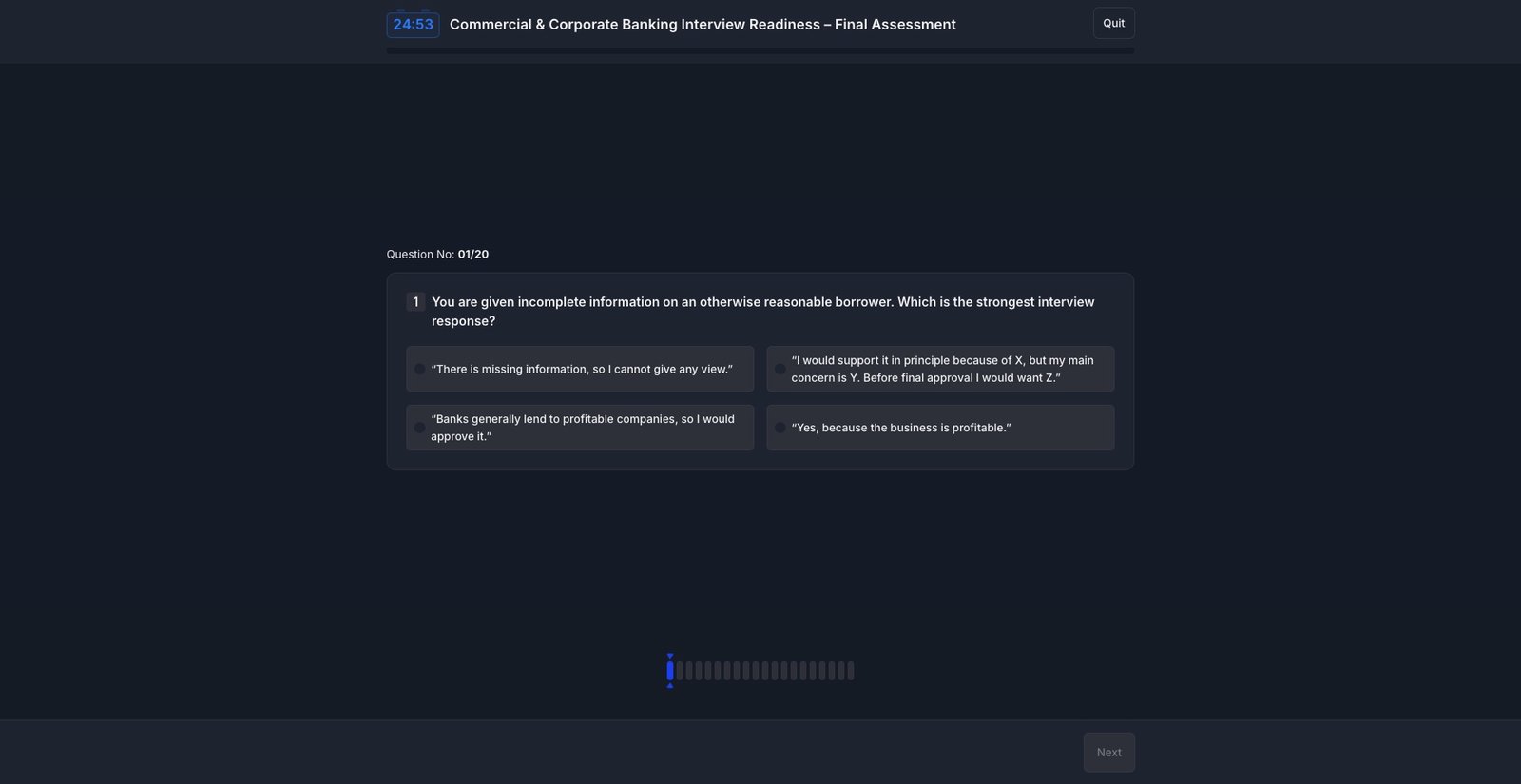
The Commercial & Corporate Banking Interview Course takes you from how a lending request moves through a bank to a full interview rehearsal. You'll work three more lending cases, under increasingly realistic pressure, then the questions that come around them.
- About three hours
- Three lending cases
- 52-question interview bank
- Lifetime access

What you'll work through
- Start HereTake the Interview Readiness Diagnostic, or the Fast Track if your interview is close.
- Commercial & Corporate BankingWhat the teams do and how a lending request moves through a bank.
- Financial & Credit AnalysisFinancial statements, cash flow, leverage and coverage.
- Lending, Debt & Credit DecisionsDebt capacity, DSCR, covenants and downside testing.
- Banking Interview MasteryMotivation, competency, technical and "Would you lend?" questions.
- Commercial Awareness & AssessmentsBank research, sector discussion and assessment centres.
- Final Interview PreparationFind your gaps, practise out loud, then take the final assessment.
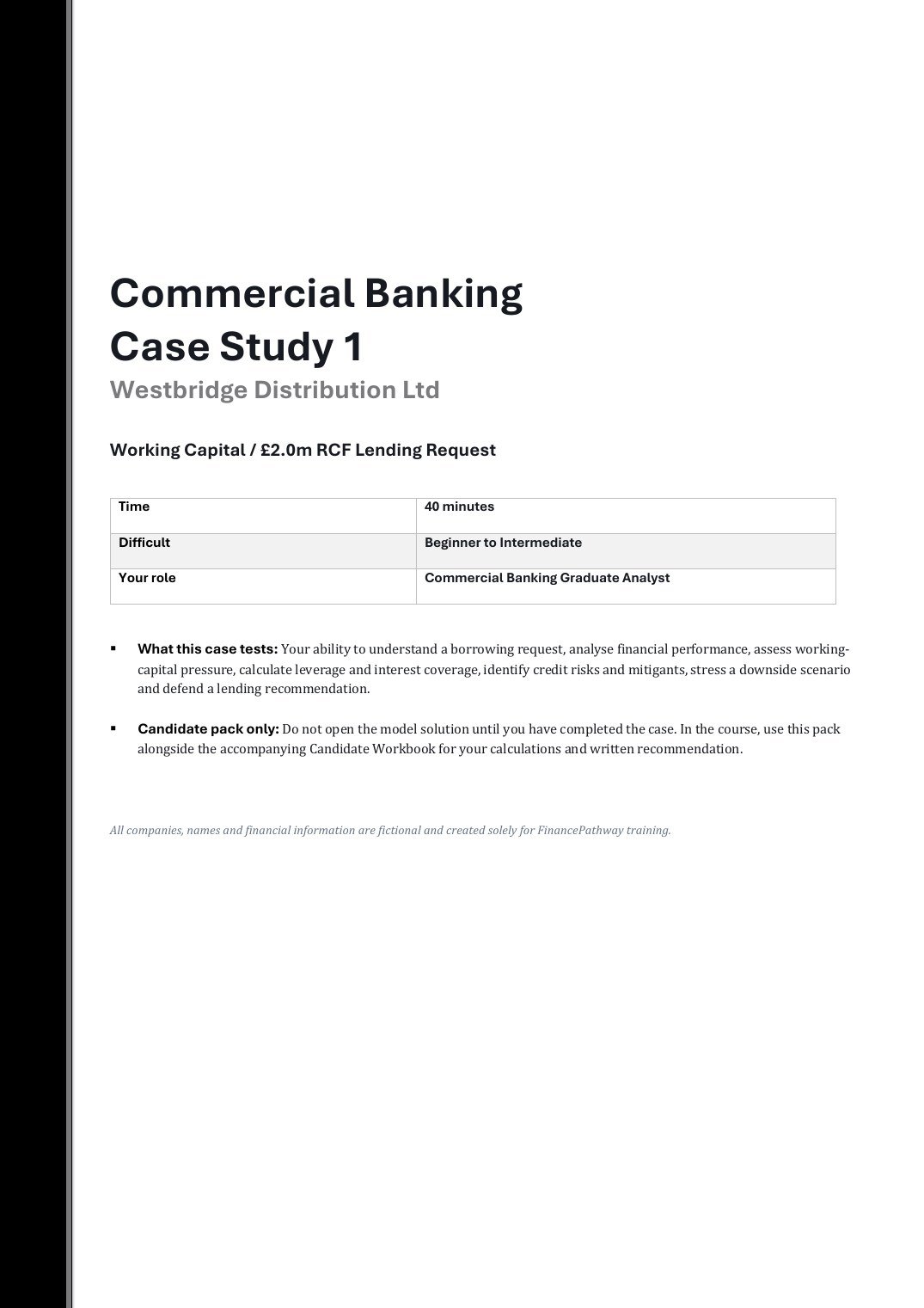
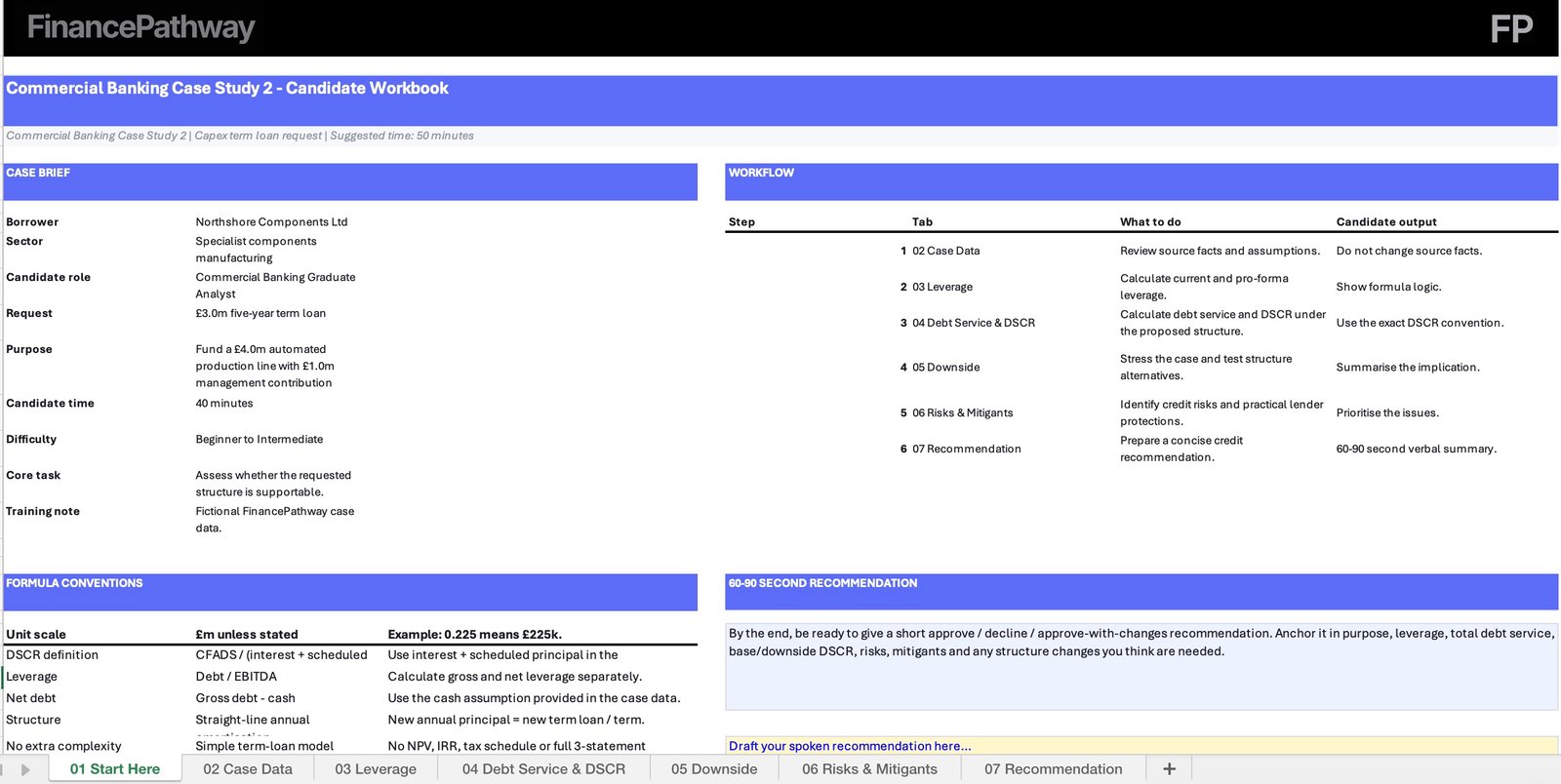
Take a look inside
Real pages from the course. Tap one to read it.
Ready to prepare for the real interview? Not ready yet? Start with 35 free commercial banking interview questions.
See the interview course