Barclays Online Assessment and Graduate Scheme Guide 2027
Barclays' 2027 UK Corporate Banking Graduate Programme is open in London, Birmingham and Leeds, with rolling recruitment and no displayed deadline, so apply early. This guide explains the Barclays online assessment, application process, Values and Mindset, assessment centre and motivational interview, with preparation focused on UK Corporate Banking. Then try 10 free practice questions, with instant answers.
Try 10 free practice questions Check application status and official vacancies
Barclays graduate opportunities at a glance
Barclays runs multiple graduate and internship programmes. If your aim is relationship-led banking with UK companies, lending, financing and financial analysis, the programme relevant to this playbook is UK Corporate Banking. Details reflect the recruitment information checked on 10 October 2026.
| Applications | Open · rolling recruitment · no displayed deadline |
|---|---|
| Locations | London · Birmingham · Leeds |
| Degree | Any subject; no classification stated |
| Salary | “Competitive pay”; no figure published. Discussed at offer and non-negotiable |
| Application limit | One graduate or internship application globally per year; only the first counts |
| Visa sponsorship | Available to successful candidates who meet Skilled Worker criteria |
UK Corporate Banking Graduate Programme 2027
The programme runs in London, Birmingham and Leeds. Barclays says successful candidates will develop relationship and technical banking skills.
You need a degree or expected degree in any subject; the vacancy doesn't state a classification. Barclays says a finance degree is generally unnecessary, and Masters, MBA and PhD students may be eligible depending on the role.
The vacancy says “competitive pay” without a figure. Barclays' FAQ says graduate packages are discussed at offer and are non-negotiable.
Still at university? UK Corporate Banking Summer Internship
If you are not yet eligible for the graduate programme, Barclays also recruits students into UK Corporate Banking summer internships.
Internships usually last six to nine weeks. Some interns go on to graduate roles, but Barclays doesn't publish an automatic offer or fast track. An internship application also uses your one Barclays application for the year.
This guide focuses on the graduate recruitment process rather than mixing the two application journeys. Explore banking opportunities →
Other Barclays graduate programmes for 2027
When we checked Barclays' official 2027 listings on 10 October 2026, these graduate programmes were also listed:
- Banking Graduate (Investment Banking: Coverage and M&A), London, live from 29 August 2026
- Capital Markets Graduate, London
- Sales, Trading and Structuring Graduate, London, live from 10 September 2026
- Global Transaction Banking Graduate, London: a Corporate Banking product route covering payments, liquidity, trade, cash management and FX
- Quantitative Analytics Graduate, London
- Retail Business Customer Banking Graduate, Northampton
- Human Resources Graduate, Glasgow
- Operations Graduate, Glasgow and Knutsford
No UK International Corporate Banking graduate vacancy was listed. International Corporate Banking graduate roles appeared in Frankfurt and Paris, and there's a London International Corporate Banking internship.
Risk, Finance and Technology graduate programmes weren't in the snapshot. That doesn't mean Barclays isn't offering them: rolling vacancies can close quickly.
Barclays UK Corporate Bank: what the work involves
UK Corporate Bank supports medium and large UK companies, from businesses with around £6.5 million of annual turnover through to FTSE 350 firms.
What Barclays says you could be doing
- Supporting and managing client relationships
- Analysing information to support client decisions
- Researching markets and business opportunities
- Preparing reports and presentations
- Working with colleagues across specialist teams
- Supporting complex corporate transactions
FinancePathway view: what that means for your application
Corporate Banking is not simply about being good with people. Your preparation should show that you can combine commercial thinking, analysis, risk awareness and communication.
- Understand what a business is trying to achieve
- Identify the information that matters
- Recognise risk rather than chase opportunity blindly
- Explain your reasoning clearly
- Know when specialists or senior colleagues should be involved
Barclays graduate application process
Barclays' graduate process has three selection stages, then an offer: your application, two initial online assessments and an assessment centre. Technical programmes add a technical skills assessment.
Your application
Choose your programme carefully. Barclays accepts one full-time graduate or internship application globally per year. If you submit more than one, only the first is considered, and an internship application uses the same allowance. If you're unsuccessful, you can reapply when the next recruitment season begins, disclosing your previous application.
Two initial online assessments
Short interactive assessments looking at how you might perform at work, your typical or preferred ways of working, and how you align with Barclays' Values. Technical programmes add a technical skills assessment.
Assessment centre
Virtual or in person, with two or three stages assessing strengths, behaviours or technical skills relevant to the role. One of these stages is a motivational interview with a member of the leadership team.
Offer
If you're successful, Barclays makes an offer. Its FAQ says graduate packages are discussed at offer and are non-negotiable.
What is the Barclays online assessment?
The Barclays online assessment is two short interactive assessments. Barclays says they look at how you might perform at work, your typical or preferred ways of working, and how you align with its Values. You can complete them on any device, including a phone or tablet.
Most are hosted on Barclays' digital experience platform, which also has information on Barclays' Purpose, Values and ways of working, plus hints, tips and practice tests.
How Barclays tells candidates to prepare
- Read the instructions carefully — Understand what each exercise is asking before responding.
- Use the practice material — Barclays recommends completing available practice and example questions first.
- Answer honestly — Do not try to manufacture the answer you think the bank wants.
- Think across the whole assessment — Barclays considers your overall performance rather than one isolated response.
A detailed 2025-cycle Banking applicant described two parts. The first was a behavioural or personality assessment where you choose the statements that best describe you; prep sites say this part is untimed. The second was a timed reasoning test they identified as SHL Verify G+, covering numerical, inductive and logical (deductive) reasoning, with no video questions. Verbal reasoning is possible but not confirmed.
Reported lengths conflict. That applicant had 24 questions in 36 minutes and said another applicant to the same programme had 8 in 12 minutes. Prep sites claim 8 in 12 or 12 in 10, so check your own invitation.
Not everyone is guaranteed an invitation: one 2027-cycle applicant took the assessment the day they applied, while another hadn't been invited. Barclays doesn't promise a feedback report, and one 2027-cycle applicant received none.
Is it SHL or Cappfinity, and what is GSA?
Barclays doesn't name a provider. SHL has the strongest evidence: a first-hand candidate report plus two prep sites. The Cappfinity claim comes from a prep page that still uses outdated Barclays stage names.
No reliable source explains “GSA”. It's likely informal shorthand for the reasoning test, so use the name shown in your invitation.
FinancePathway judgement framework
For Corporate Banking workplace scenarios, use this framework to structure how you think:
- Client objective — What is the client trying to achieve?
- Information — What do you know and what is still missing?
- Risk — What could go wrong if you act too quickly?
- Stakeholders — Who should know, help or approve?
- Action — What is the most proportionate next step?
Barclays Values and Mindset
Barclays' Values and Mindset are useful context for both the online assessment and later interview. “Values and Mindset assessment” is what candidates and prep sites commonly call the behavioural part of the online assessment; it isn't a separate official stage. Barclays' Values are what it believes is right, and its Mindset is how it expects people to work. The goal is not to memorise words — it is to understand what good professional behaviour looks like.
Barclays Values: Respect · Integrity · Service · Excellence · Stewardship
Barclays summarises these as RISES. Think about what each means when dealing with a client, colleague, deadline, control issue or difficult decision.
Barclays Mindset: Empower · Challenge · Drive
Use these to pressure-test your examples. Did you take ownership? Did you challenge constructively? Did you move the situation forward?
How to pass the Barclays online assessment
There is no credible shortcut to a guaranteed pass, and Barclays publishes no pass mark. Candidates report real time pressure on the reasoning part, so practise working accurately at pace. Use the practice tests on Barclays' digital experience platform, read every instruction and answer the behavioural items honestly.
If most of your preparation is spent searching for alleged live answers rather than improving your judgement, you are preparing for the wrong thing.
Barclays LifeSkills, which often ranks first for this search, is Barclays' free employability programme for students. Its skills-test guidance is general and isn't the graduate recruitment assessment.
Invited to the Barclays online assessment? The Barclays Practice Pack includes 48 numerical, inductive and deductive drills and two timed 24-item mixed mocks, the length one 2025-cycle candidate reported (Barclays doesn't publish an official length), all with worked answers.
Free Barclays online assessment practice questions
Numerical, inductive and deductive reasoning, a UK Corporate Banking client case and motivational-interview practice, with instant feedback on every answer.
Original FinancePathway practice, not real or leaked Barclays questions, and it does not reproduce Barclays' scoring. Barclays does not publish its test format; a 2025-cycle Banking applicant reported a timed test mixing numerical, inductive and deductive items. The per-question target times and “2 min prep” interview timings are FinancePathway's practice pacing, not Barclays' published timings.
Start the free sample
- Question 1
- Question 2
- Question 3
- Question 4
- Question 5
- Question 6
- Question 7
- Question 8
- Question 9
- Question 10
Halden’s banking covenant requires net debt / EBITDA of no more than 3.0x. With FY2026 net debt unchanged, by what percentage could FY2026 EBITDA fall before the covenant is breached?
| Year to 31 December | FY2024 | FY2025 | FY2026 |
|---|---|---|---|
| Revenue | 840 | 924 | 1,012 |
| EBITDA | 126 | 148 | 172 |
| Depreciation & amortisation (D&A) | 30 | 34 | 38 |
| Net interest | 18 | 20 | 22 |
| Net debt at year end | 390 | 420 | 430 |
| Shares in issue at year end (m) | 200 | 200 | 200 |
| Share price at year end (£) | 4.20 | 5.10 | 6.00 |
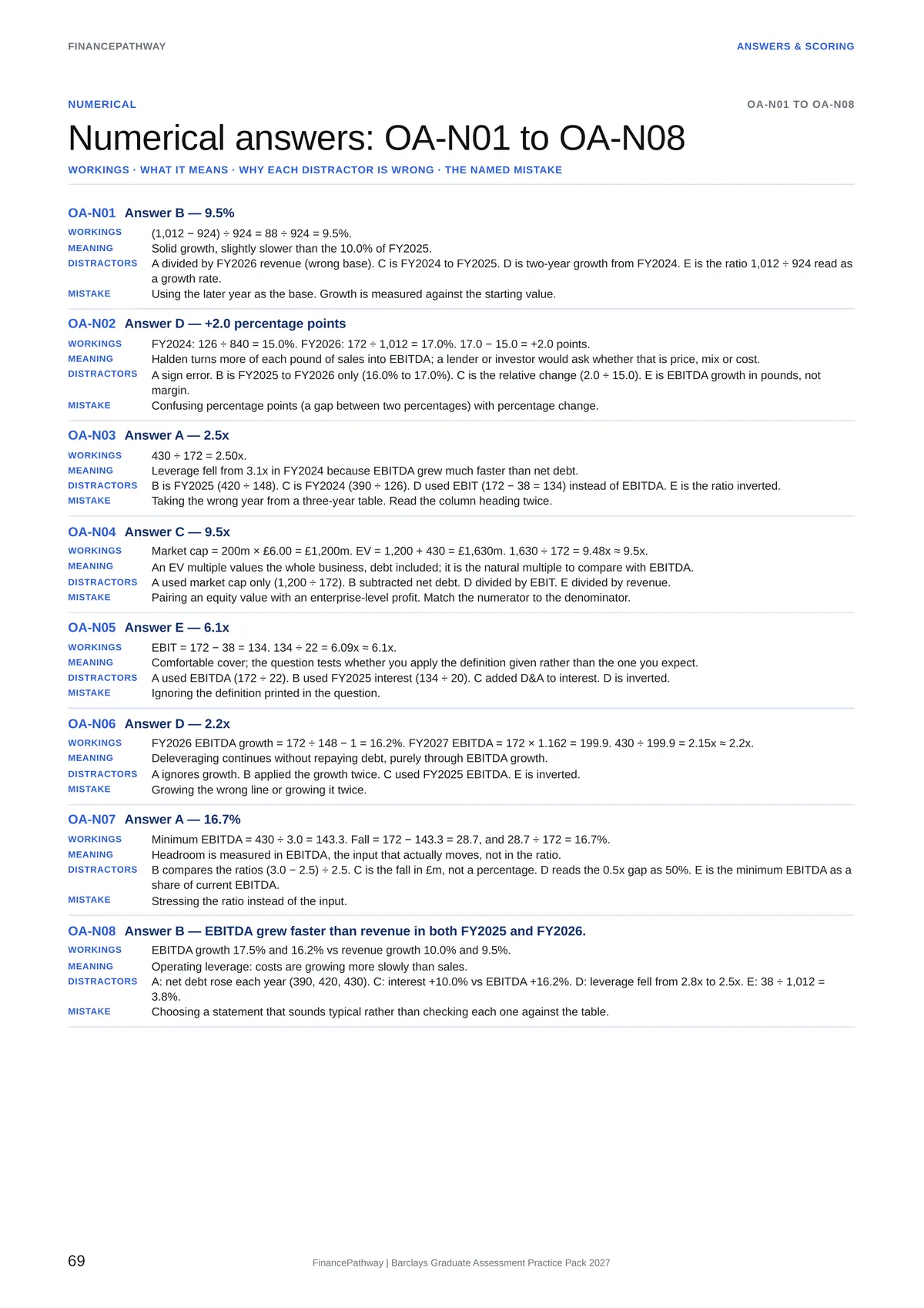
EBITDA can fall to £143.3m (430 ÷ 3.0) before the covenant is breached. That is a fall of £28.7m, or 16.7% of £172m.
See the working
Working: minimum EBITDA = 430 ÷ 3.0 = 143.3. Fall = 172 − 143.3 = 28.7, and 28.7 ÷ 172 = 16.7%.
What it means: headroom is measured in EBITDA, the input that actually moves, not in the ratio.
Common mistakes: B compares the ratios, (3.0 − 2.5) ÷ 2.5. C is the fall in £m, not a percentage. D reads the 0.5x gap as 50%. E is the minimum EBITDA as a share of current EBITDA.
Loan M has a valuation that is 15 months old, and it has been approved. Which of the following must be true?
A lender applies these rules to every loan. Use only the rules given, not outside knowledge about banks or lending.
- A loan above £5m can only be approved by the credit committee.
- The credit committee approves only loans that have an independent valuation.
- The credit committee never approves a loan whose valuation is more than 12 months old.
- Some property loans are above £5m.
- Loan K is a £7m property loan.
The committee never approves a valuation over 12 months old, so M was approved outside the committee. Only the committee can approve loans above £5m, so M is not above £5m.
See the working
Why the others fail: A contradicts rule 3. E can't be true, because Loan K is above £5m and Loan M isn't. B could be true, but nothing forces it. D can't be decided, because rule 2 only applies to loans the committee approves. Rule 4 is there to distract you.
Common mistakes: reversing a rule, or confusing what must be true with what could be true.
Why Barclays? Give two reasons that would not be equally true of another large UK bank.
Prepare, then answer aloud. For each reason: the reason, your evidence, the link to Barclays or the division, and what you would contribute.
A strong answer
- Two specific, checkable features of Barclays: how it is organised, where it is focusing, or the programme itself.
- A personal reason each one matters to you, backed by your own experience.
- At most one dated fact, used as something you want to learn about rather than flattery.
- Nothing that would be equally true of any other large bank.
Read the model answer from the pack
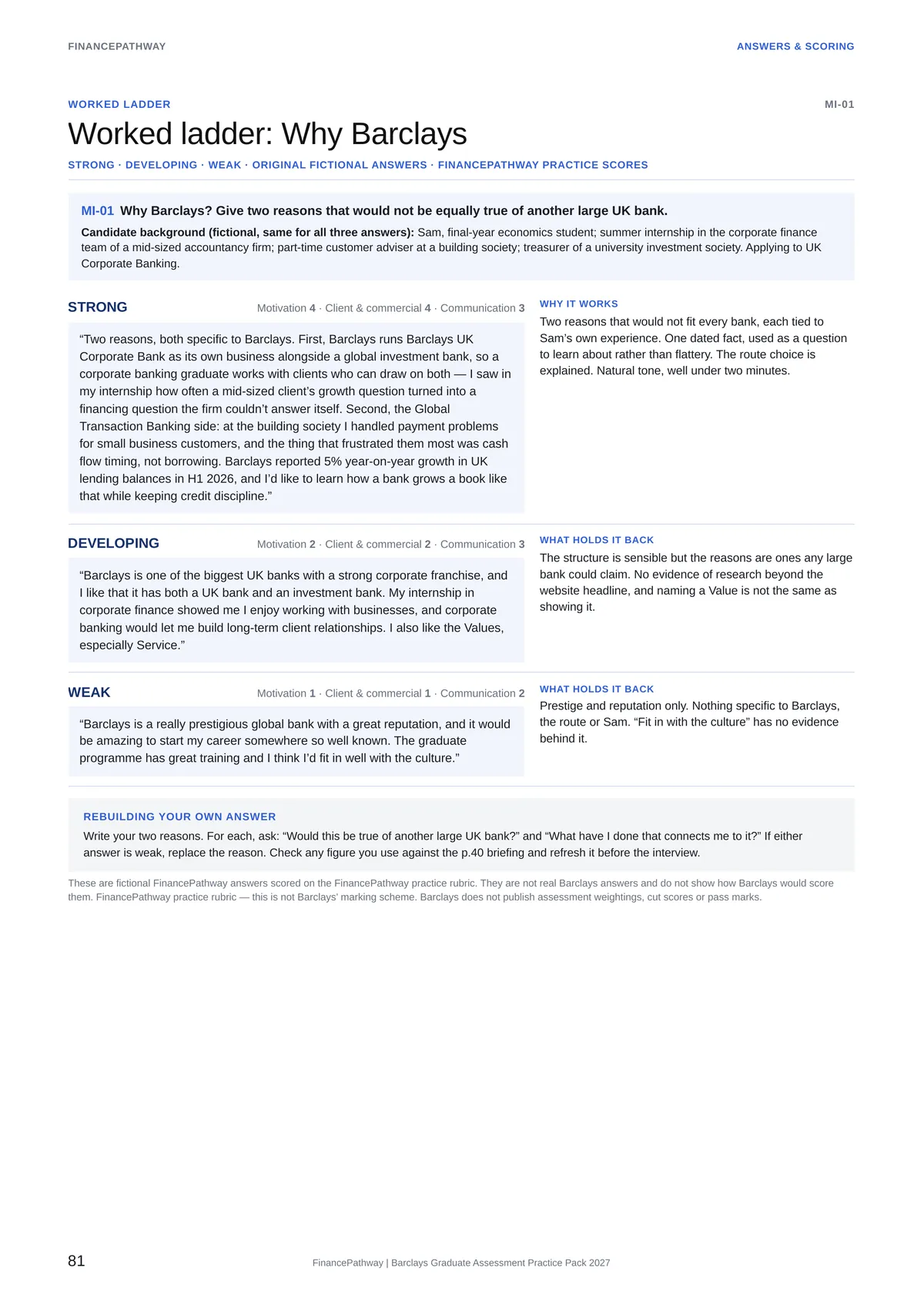
Fictional candidate Sam: final-year economics student, corporate finance internship, part-time building society adviser, applying to UK Corporate Banking.
“Two reasons, both specific to Barclays. First, Barclays runs Barclays UK Corporate Bank as its own business alongside a global investment bank, so a corporate banking graduate works with clients who can draw on both — I saw in my internship how often a mid-sized client’s growth question turned into a financing question the firm couldn’t answer itself. Second, the Global Transaction Banking side: at the building society I handled payment problems for small business customers, and the thing that frustrated them most was cash flow timing, not borrowing. Barclays reported 5% year-on-year growth in UK lending balances in H1 2026, and I’d like to learn how a bank grows a book like that while keeping credit discipline.”
Common weak pattern: reputation, size or “global bank”, reasons that fit any competitor. FinancePathway practice rubric, not Barclays scoring. Check any figure you use before your interview.
Unlock seven more questions, free
Email sign-up is not available at the moment.
Admin note (only visible when logged in): add the Hostinger Reach widget with the CSS class fp-sample-gate-form below this HTML widget.
We'll email you a link back to the questions and a few short Barclays prep emails, which mention our practice packs. Unsubscribe any time. Privacy policy
Questions 4 to 10 are unlocked
We have also emailed you a link so you can come back to them. If it has not arrived within a few minutes, check your promotions or spam folder.
Each row follows the same rule. Which number replaces the question mark?
| Row | First | Second | Third |
|---|---|---|---|
| 1 | 3 | 4 | 9 |
| 2 | 5 | 2 | 5 |
| 3 | 6 | 3 | 12 |
| 4 | 7 | 5 | ? |
In every row, the third number is the first multiplied by one less than the second, so 7 × (5 − 1) = 28.
See the working
Check the rule on every row: 3 × 3 = 9, 5 × 1 = 5 and 6 × 2 = 12. Then 7 × 4 = 28.
Common mistakes: E multiplies without the adjustment, D subtracts the second number instead of the first, B takes one off both numbers, and A adds them. A rule isn't the rule until it fits every row.
By how much did aerospace’s share of total revenue change between FY2025 and FY2026?
Revenue by customer segment for a fictional UK engineering client (£m).
| Segment | FY2025 | FY2026 |
|---|---|---|
| Automotive | 48 | 54 |
| Aerospace | 30 | 39 |
| Industrial | 42 | 39 |
| Total | 120 | 132 |
Aerospace’s share rose from 25.0% (30 ÷ 120) to 29.5% (39 ÷ 132), an increase of 4.5 percentage points.
See the working
What it means: aerospace grew 30% while industrial shrank, so the client now depends more on one sector. That is the kind of change a relationship team would want to understand.
Common mistakes: B divides by the FY2025 total for both years. C is the £m increase. D is the percentage change in the share, not the change in percentage points. E is aerospace’s revenue growth.
Client R was offered a new facility without director sign-off. Which of the following must be true?
A bank applies these rules. Use only the rules given.
- Every client on the watch list has had a credit review in the last three months.
- A client who has had a credit review in the last three months cannot be offered a new facility without director sign-off.
- Some clients in the Leeds team are on the watch list.
R was offered a facility without sign-off, so R can’t have had a recent credit review (rule 2). Every client on the watch list has had one (rule 1), so R isn’t on the watch list.
See the working
Why the others fail: A could be true, but nothing forces it. C contradicts rule 2. D is false, because the Leeds clients on the watch list have all had a review. E can’t be decided from the rules.
Common mistake: working forwards only. Here you have to run two rules backwards: no sign-off means no recent review, and no recent review means not on the watch list.
What should the relationship team explore first?
A family-owned food manufacturer banks with your team. Last year it won a contract with a national supermarket, and revenue grew 25% to £30m. Margins are stable, but the supermarket pays on 60-day terms and the company’s debtor days have risen from 35 to 60. The finance director asks to double the overdraft from £2m to £4m.
The cash is tied up in money the supermarket owes, so start by matching the facility to that need. Invoice finance grows with sales; a fixed overdraft doesn’t.
See the working
Rough check: at 60 days, receivables on £30m of sales are about £4.9m, against about £2.3m before the contract (£24m at 35 days). That extra £2.6m is the funding gap.
Why the others come later: A is about security, which only matters once you know the right structure. B is worth discussing, but the supermarket sets its own terms. C jumps to a decision; customer concentration is a risk to assess, not an automatic no. E is a fair question, but margins aren’t the problem here. The timing of cash is.
This follows the guide’s framework: client objective, information, risk, stakeholders, action. FinancePathway practice key, not Barclays scoring.
What is the total cost of the facility for the 90 days?
A client has a £5m revolving credit facility and draws £3.6m for 90 days. Interest is 7% a year on the amount drawn, and a commitment fee of 0.5% a year is charged on the amount not drawn. Use a 365-day year.
Interest on the £3.6m drawn is £62,137 and the fee on the £1.4m not drawn is £1,726, so the 90 days cost £63,863.
See the working
Working: £3,600,000 × 7% × 90 ÷ 365 = £62,137. £1,400,000 × 0.5% × 90 ÷ 365 = £1,726.
What it means: the commitment fee is what the client pays to keep the rest of the facility available, even when it isn’t used.
Common mistakes: A leaves out the fee. C uses a 360-day year. D charges the fee on the whole facility. E is the cost for a full year.
Why UK Corporate Banking, rather than investment banking?
Prepare, then answer aloud. Give your answer in the first sentence, then back it up with something you have done or seen yourself.
A strong answer
- Shows you understand the difference: long-term relationships, lending and everyday banking for companies, rather than work built around individual transactions.
- Gives a reason from your own experience for preferring the relationship side.
- Shows you know who the clients are: medium and large UK companies, and what they need from a bank.
- Doesn’t criticise investment banking or sound like a second choice.
Read an example answer
“Because I want to get to know a business over years, not just around one transaction. In my corporate finance internship I worked on a company sale. It was exciting, but once it completed, our involvement ended. At the building society, the most useful conversations were with the same business customers month after month, when I could see their cash flow and help them plan. UK Corporate Banking combines both: analysing a company properly, then staying with it as it grows.”
Score yourself out of 4, one point for each item above. Common trap: describing Corporate Banking as a safer or easier version of investment banking. FinancePathway practice rubric, not Barclays scoring.
Tell me about a time you challenged someone’s view.
Answer aloud in two minutes. Then answer the two follow-ups an interviewer is likely to ask: “How did the other person feel about it afterwards?” and “What would you do differently next time?”
A strong answer
- A real disagreement that mattered, not a minor preference.
- A challenge based on evidence and made respectfully, after listening to the other view.
- An honest outcome, including where you were only partly right.
- Follow-up answers that hold up: a fair account of the other person’s view and one specific thing you would change.
Score yourself out of 4, one point for each item above. This maps to Challenge in the Barclays Mindset and Respect in its Values. Follow-ups test whether a story is real, so prepare them as carefully as the main answer. Common trap: a story where the other person was simply wrong. FinancePathway practice rubric, not Barclays scoring.
Take a look inside
Three real pages from the pack. Tap a page to read.

Barclays assessment centre and motivational interview
Barclays says its assessment centre may be virtual or in person and includes two or three stages assessing strengths, behaviours or technical skills relevant to the role, including a motivational interview with a member of the leadership team. It doesn't publish the length or the other exercises, and it doesn't promise a feedback report afterwards.
A graduate candidate in the previous cycle, whose programme wasn't identified, reported an in-person final stage at Barclays' London office. Barclays hasn't said whether 2027 UK Corporate Banking centres will be virtual or in person.
Motivation: why Barclays?
"It's a leading global bank" is not enough. Find two or three reasons that are genuinely specific to Barclays and explain why each matters to you.
Barclays' own guidance: research Barclays, the business area and the specific programme, and how your experience and strengths connect to the role.
Role fit: why Corporate Banking?
Explain why you like the combination of companies, relationships, financial analysis, financing and long-term client coverage.
The UK Corporate Banking vacancy says Barclays values interest in the UK corporate marketplace, analytical ability, translating data, communication, resourcefulness, teamwork, enthusiasm and entrepreneurial spirit. Have an example for each.
Behaviours: tell me about a time when...
Prepare evidence covering judgement, teamwork, challenge, communication, ownership, resilience and problem solving, plus your personal strengths and what you're working to develop.
Commercial thinking: can you understand a business?
No formal technical test is confirmed, but you should be able to explain the business, its clients and why companies use corporate banks. Be able to explain how a company makes money, what drives cash, what could put repayment at risk and where a bank could support it.
Build technical confidence
You do not need to turn yourself into an investment banker. You do need to understand the foundations of assessing a company and its debt capacity.
Learn credit analysis →Practise applying it
Once you understand the concepts, work through a business case rather than endlessly reading technical articles.
Try the Commercial Banking case study →Invited to the assessment centre? The pack includes 28 motivational-interview questions, 10 follow-up question chains and UK Corporate Banking client cases, with strong, developing and weak model answers, so you can rehearse before the day.
How to prepare for Barclays in seven days
Do not spend seven days passively reading about Barclays. By the middle of the week you should be practising and applying what you have learned.
Your ticks are saved in this browser only. No account needed.
- Day 1
Know the clients, products, role and why it genuinely appeals to you.
- Day 2
Prepare why Barclays and map your strongest experiences to its Values and Mindset.
- Day 3
Read Barclays' official guidance and complete available practice material.
- Day 4
Analyse a real business: how does it make money, why might it borrow, what could go wrong and what information would you want?
- Day 5
Prepare evidence for motivation, teamwork, judgement, challenge, resilience and leadership.
- Day 6
Give answers aloud and practise unfamiliar commercial scenarios.
- Day 7
Complete one final run-through and check your technology, instructions and interview setup.
Barclays application FAQs
These answers cover common questions about the Barclays graduate scheme, online assessment and recruitment process.
When does the Barclays graduate scheme open, and what is the deadline?
The 2027 UK Corporate Banking programme is open, with no displayed deadline. The London vacancy went live on 1 September 2026, and London, Birmingham and Leeds were all open when we checked on 10 October 2026. Barclays fills vacancies on a rolling, first-come-first-served basis and can close them once hiring needs are met, so apply early. Last cycle, one applicant recalled many vacancies closing within days.
What other Barclays graduate programmes are there for 2027?
On 10 October 2026, Barclays' 2027 listings included Banking (Investment Banking), Capital Markets, Sales, Trading and Structuring, Global Transaction Banking and Quantitative Analytics in London, Retail Business Customer Banking in Northampton, Human Resources in Glasgow, and Operations in Glasgow and Knutsford. Risk, Finance and Technology weren't listed then, but that doesn't mean they aren't offered. See other programmes.
What's the difference between UK Corporate Banking and International Corporate Banking?
UK Corporate Banking covers Barclays' UK corporate clients, from businesses with around £6.5 million of turnover to FTSE 350 firms. International Corporate Banking is a separate route. No UK International Corporate Banking graduate vacancy was listed on 10 October 2026: its graduate roles appeared in Frankfurt and Paris, and there's a London International Corporate Banking internship. Check which route a vacancy belongs to before applying.
Do Barclays internships use the same online assessment, and do interns get graduate offers?
Barclays describes one process for internships and graduate programmes: an application, two online assessments and an assessment centre, though some routes differ. Internships usually last six to nine weeks. Some interns go on to graduate roles, but Barclays doesn't publish an automatic offer or fast track. An internship application also uses your one Barclays application for the year.
Does Barclays sponsor graduate visas?
For UK Corporate Banking, yes if you qualify. The 2027 vacancy accepts applicants who need sponsorship and will provide a Skilled Worker visa to successful candidates who meet Home Office criteria. If you're not eligible for sponsorship, you need full-time UK work rights from August 2027 to August 2029. Other programmes set their own rules, so check each vacancy.
Can I apply for more than one Barclays graduate scheme?
No. Barclays accepts one full-time graduate or internship application globally per year. If you submit more than one, only the first is considered, and an internship application uses the same allowance. If you're unsuccessful, you can reapply when the next recruitment season begins, and Barclays asks you to disclose previous applications.
Can I get adjustments for the Barclays assessment?
Yes. Barclays allows candidates to request reasonable recruitment adjustments, and says adjustments it has made include additional time and offline assessments. Tell the recruitment team what you need as early as you can, so it can be arranged before your assessment. Barclays recruitment adjustments →
What are the stages of the Barclays recruitment process?
For a standard graduate programme, there are three stages before an offer: your application, two initial online assessments, and an assessment centre with two or three stages, including a motivational interview with a member of the leadership team. Technical programmes add a technical skills assessment, and some routes add a live interview. See the application process.
What is the Barclays online assessment?
It's two short interactive assessments that look at how you might perform at work, your preferred ways of working and how you align with Barclays' Values. A 2025-cycle Banking applicant described a behavioural assessment, where you choose the statements that best describe you, followed by a timed reasoning test they identified as SHL Verify G+. Barclays doesn't publish the exact format. See the online assessment.
Does everyone get to do the Barclays online assessment?
Not necessarily. Barclays doesn't promise every applicant an invitation. One 2027-cycle applicant took the assessment the day they applied, while another hadn't been invited even though their application status had changed. So an invitation may not arrive straight away; check your application portal and emails.
How long is the Barclays online assessment, and how many questions are there?
Barclays doesn't publish a question count or time limit, and reports conflict. A 2025-cycle Banking applicant had 24 reasoning questions in 36 minutes and said another applicant to the same programme had 8 in 12 minutes. Prep sites claim 8 in 12 or 12 in 10. The behavioural part is reported to be untimed. Check the instructions in your own invitation.
Is there a Barclays numerical reasoning test?
Numerical reasoning is reported, but Barclays doesn't publish its sub-tests. A 2025-cycle Banking applicant described a timed reasoning test they identified as SHL Verify G+, covering numerical, inductive and logical (deductive) reasoning. Verbal reasoning is possible but not confirmed. Practise reading tables and charts accurately under time pressure.
Is the Barclays online assessment SHL or Cappfinity?
Barclays doesn't name a provider, but SHL has the strongest evidence: a 2025-cycle Banking applicant identified their reasoning test as SHL Verify G+, and two prep sites also point to SHL. The Cappfinity claim comes from a prep page that still uses outdated Barclays stage names. Neither is confirmed, so prepare for the formats in your invitation.
What is the Barclays GSA assessment?
No reliable source explains “GSA”, and Barclays doesn't use it in its published process. It's likely informal shorthand for the reasoning test, which a 2025-cycle applicant identified as SHL Verify G+. Use the name shown in your own invitation, and be wary of sites that give an official expansion.
What are Barclays Values and Mindset?
Barclays' Values are Respect, Integrity, Service, Excellence and Stewardship: what it believes is right. Its Mindset is Empower, Challenge and Drive: how it expects people to work. “Values and Mindset assessment” is the common candidate and prep-site name for the behavioural part of the online assessment, not a separate official stage.
How hard is the Barclays online assessment?
The reasoning part is the hard bit: candidates report real time pressure. Barclays publishes no pass mark, and reported lengths vary, from 8 questions in 12 minutes to 24 in 36. The behavioural part is reported to be untimed, so answer it honestly rather than quickly. Practise accuracy at pace, and use Barclays' own practice tests first.
How do I pass the Barclays online assessment?
There's no published pass mark, so focus on preparation. Barclays advises reading every instruction, completing the practice and example questions, and answering the behavioural items honestly. Expect time pressure on the reasoning part, so practise working accurately at pace. Barclays' digital experience platform has hints, tips and practice tests, and you can try our free questions.
Where can I practise the Barclays online assessment?
Start with Barclays' own material. Most assessments are hosted on its digital experience platform, which has hints, tips and practice tests, plus information on Barclays' Purpose, Values and ways of working. Barclays advises completing the practice and example questions before the real thing. Barclays LifeSkills is a separate employability programme, not the graduate assessment. You can also try our free questions.
Can I do the Barclays online assessment on my phone?
Yes. Barclays says its two interactive assessments can be completed on any device, including a phone or tablet. For the timed reasoning part, a larger screen may make tables and charts easier to read, and a quiet place with a stable connection helps. Follow any device guidance in your invitation.
Do I get feedback on the Barclays online assessment?
Don't count on it. Barclays doesn't promise a feedback report after the online assessment, and one 2027-cycle applicant said they received none after completing it. Barclays also doesn't promise a feedback report after the assessment centre. Keep your own notes on what felt hard so you can target your practice if you reapply in a later season.
What does “Screen Tests in Progress” mean on my Barclays application?
It appears to be a Workday screening status meaning your application is still in Barclays' screening and assessment workflow. It isn't confirmation that you've passed or failed. Candidates in this cycle and the last report sitting at this status for weeks; one 2027-cycle applicant was still there about 26 days after the assessment. Some applications later move to “Preliminary Conversations”, whose meaning Barclays doesn't publish.
What happens after the Barclays online assessment?
Successful candidates are invited to the assessment centre, but Barclays publishes no turnaround time. Your status may show “Screen Tests in Progress” for weeks: one 2027-cycle applicant was still waiting about 26 days after completing the assessment. Candidates report the process moving quickly at first and slowly after the online assessment. See Screen Tests in Progress.
How long does it take to hear back from Barclays?
There's no published timescale. Candidates report Barclays moving quickly at first and slowly after the online assessment, with waits of weeks at “Screen Tests in Progress”. One graduate candidate in the previous cycle, programme not identified, reported a four-month process from start to finish. Barclays doesn't publish a turnaround after the assessment centre either.
What happens at the Barclays assessment centre?
Barclays says it can be virtual or in person, with two or three stages assessing strengths, behaviours or technical skills relevant to the role, including a motivational interview with a member of the leadership team. It doesn't publish a length or the other exercises. A previous-cycle graduate candidate reported an in-person final stage at Barclays' London office. See the assessment centre.
Is there a Barclays case study, Business Meeting or e-tray?
None is confirmed for 2027 UK Corporate Banking. Barclays doesn't currently use the names “Business Meeting” or “Business Insight”, and a September 2026 prep review says they come from its older process. Ignore claims of a fixed 3.5–5 hour Business Meeting, an e-tray or a set case study unless your invitation uses that format. Prepare your commercial reasoning either way.
Does Barclays use a video interview?
Not in Barclays' standard graduate process, which goes from the online assessments to the assessment centre, and a 2025-cycle Banking applicant reported no video questions in the online assessment. Some routes differ: a 2027 London Banking (Investment Banking) Summer Internship applicant reported a 20–30 minute live interview with a recruiter before the assessment centre. Follow your own invitation.
What Barclays interview questions should I prepare for?
Prepare themes, not memorised questions. Barclays' guidance says to research Barclays, the business area and the programme, and how your experience and strengths fit the role. The UK Corporate Banking vacancy values interest in the UK corporate market, analysis, translating data, communication, resourcefulness, teamwork, enthusiasm and entrepreneurial spirit. Prepare examples for these, plus your strengths and development areas.
What is the Barclays graduate scheme salary?
Barclays doesn't publish a figure. The 2027 UK Corporate Banking vacancy says “competitive pay”, and Barclays' FAQ says graduate and intern packages are discussed at offer and are non-negotiable. Be wary of salary figures from other Barclays businesses or older cycles, which may not apply to this programme.
Is it hard to get hired at Barclays?
It's selective, but Barclays publishes no acceptance rate or applications per place, so ignore sites quoting precise percentages. What is clear is that Barclays recruits on a rolling, first-come-first-served basis and recommends applying early, and candidates report time pressure in the online reasoning test. Your strongest edge is preparation and an early application.
FinancePathway is an independent careers resource and is not affiliated with or endorsed by Barclays. Our practice packs do not contain leaked or live Barclays assessment questions. Programme availability, assessment formats, eligibility and recruitment processes can change. Your Barclays vacancy, candidate portal and assessment invitation should always be treated as the final source of truth.