NatWest Graduate Scheme 2027: Commercial Banking Application Guide
Applications are open for NatWest's 2027 Commercial Banking graduate programme, while Corporate & Institutional Banking has now closed. This guide helps you prepare for every stage, from Work Scenarios and the Online Skills assessment to the Virtual Assessment Centre. Then try 10 free practice questions, with instant answers.
Try 10 free practice questions
NatWest graduate schemes at a glance
For candidates interested in commercial and corporate banking, the two most relevant NatWest graduate routes are Commercial Banking Relationship Management and Corporate & Institutional Banking. Both are two-year graduate programmes starting in September 2027, but the clients, work and starting salary differ materially.
| Programme | Commercial Banking Relationship Management | Corporate & Institutional Banking |
|---|---|---|
| Salary | £37,500. When we checked on 29 September 2026, the London vacancy listed an additional £3,450 location allowance. | £60,000 |
| Duration | 2 years | 2 years |
| Start date | September 2027 | September 2027 |
| Applications | Open; closes once the cohort is filled | Closed for 2027 entry |
| Degree requirement | 2:1 | 2:1 |
| Location | Birmingham, Bristol, Edinburgh, London & Manchester | London |
| CV required | Yes | Yes |
| Applications allowed | One programme in one location | |
| Visa sponsorship | Programme dependent; check the live vacancy | |
On smaller screens, swipe across the table to compare both routes.
Programme descriptions, locations and official links
Commercial Banking Relationship Management
A two-year graduate route focused on understanding businesses, developing customer relationships and learning how banking, lending and financing solutions can support customers' ambitions.
NatWest's Commercial Banking Relationship Management graduate roles are in Birmingham, Bristol, Edinburgh, London and Manchester. When we checked on 29 September 2026, the London vacancy listed an additional £3,450 location allowance.
View the official programme →Corporate & Institutional Banking Graduate Programme
A two-year programme working with larger and more complex corporate and institutional clients across financing, transaction banking, risk management and specialist banking solutions.
NatWest says graduates develop financial and credit-risk analysis, product knowledge, commercial awareness, problem solving and stakeholder-management skills.
View the official programme →Other NatWest graduate programmes for 2027
NatWest's graduate programme families for 2027 are Commercial Banking, Corporate & Institutional Banking, Data Science, Economic Crime, Engineering, Finance, NatWest Markets, Private Banking & Wealth Management, RBS International and Risk. NatWest accepts only one graduate application, so compare them before you apply.
- Finance: £37,500, 3 years
- Risk: £37,500, 2 years, STEM 2:1
- Economic Crime: £37,500, 2 years
- Private Banking & Wealth Management: £37,500, 2 years
- RBS International: £37,500, 2 years, based in Jersey
- Data Science: £42,000 nationally or £52,000 in London, 1 year, STEM 2:1
- Engineering: £42,000 nationally or £52,000 in London, 1 year, STEM 2:1
- NatWest Markets: a permanent role at £60,000 for UK Front Office or £70,000 for UK Quantitative Analyst, the highest published graduate salary
Engineering uses a different process: the Online Skills assessment plus SQL and coding tests, before the video and assessment centre.
Financing Solutions and Digital Transformation are no longer separate programmes. Financing work now sits within CIB and NatWest Markets, and the technology route is Engineering.
Closing dates vary by programme and location. See all NatWest graduate programmes →
Still at university? Summer internships
NatWest Commercial Banking versus Corporate & Institutional Banking
Do not choose between these NatWest graduate programmes based only on the starting salary. The customer base, products and nature of the work are different.
Commercial Banking: relationship-led banking for UK businesses
Commercial Banking is centred on understanding businesses, their ambitions and the banking support they need. Customer relationships, commercial judgement and the ability to understand financial information all matter.
You may build exposure to lending, credit, customer strategy, products and the wider issues affecting UK businesses.
After the programme, NatWest says previous graduates have moved into roles including Assistant Relationship Director, Portfolio Manager, Relationship Manager and Product Owner.
This route is likely to suit candidates who enjoy talking to businesses, understanding how companies operate and combining relationship skills with financial analysis.
Explore Commercial Banking careers →Corporate & Institutional Banking: complex clients, financing and specialist products
NatWest CIB supports larger corporate and institutional clients with financing, transaction banking, risk-management and specialist solutions.
Graduate work can involve financial and credit analysis, understanding funding requirements, developing financing solutions and working across Coverage, Product and Risk teams.
After the programme, NatWest says graduates can progress to Associate roles across Customer Coverage, Product and Sustainable Finance.
This route is closer to large-cap corporate and wholesale banking than traditional mid-market Commercial Banking.
Compare Corporate vs Commercial Banking →NatWest graduate scheme application process
NatWest's current process for non-engineering graduate programmes uses a series of online stages before a full-day Virtual Assessment Centre. NatWest also says it accepts only your first graduate programme application, so choose the programme and location carefully. You can apply whenever you graduated, as long as you meet the programme's degree requirement.
Application and CV
Complete the eligibility questions and upload your CV through NatWest's application system. The first assessment opens once you submit, and you have 10 days to complete the online assessments in full.
Work Scenarios
You are shown work-related scenarios and statements and decide how effective or ineffective different responses would be in each situation.
Online Skills assessment
You choose statements that best describe you, rate your preferences, and work through tasks that involve analysing information and solving problems. NatWest says it takes around 30–35 minutes.
Video recording
Successful candidates complete six recorded responses covering motivation, experience and hypothetical workplace scenarios. Two candidates in the 2027 cycle report that passing the video put them on a shortlist for a limited number of assessment centre places, rather than guaranteeing an invitation.
Virtual Assessment Centre
NatWest describes a full-day virtual assessment including interactive activities such as group discussion, role play and interview.
Offer
NatWest communicates the outcome after the assessment centre. Successful candidates then complete the relevant pre-employment checks.
NatWest online assessment: Work Scenarios and Online Skills
Your online candidate assessment comes in two parts: Work Scenarios, then the Online Skills assessment. NatWest's careers site now calls the second part Online Skills, but some invitations, older guides and prep sites still call it “Job Focus”. It's the same stage, so prepare for whatever your invitation describes.
What NatWest currently confirms
- 14 Work Scenarios — Workplace situations are presented with statements that you assess as more or less effective.
- Around 20–25 minutes — NatWest says Work Scenarios usually takes this long, although candidates have unlimited time to complete it.
- Feedback report — NatWest emails you a feedback report after Work Scenarios. Online Skills gives no personalised feedback.
- Online Skills assessment — You choose statements that best describe you, rate your preferences, analyse information and solve problems.
- Around 30–35 minutes — NatWest says Online Skills takes around 30–35 minutes in total, and most sections are untimed.
- Examples first, calculator recommended — NatWest shows example items before the real tasks and recommends having a pen, paper and calculator ready.
- 10 days to complete — You have 10 days from submitting your application to complete the online assessments in full. NatWest sends a reminder on day 7.
- No published pass mark — NatWest doesn't publish a pass mark for either assessment.
What should you prepare?
Work on reading scenarios carefully, identifying the real objective, understanding the customer or colleague perspective and selecting proportionate actions. For Online Skills, practise working calmly through unfamiliar information and problems rather than trying to memorise a supposed answer key, and answer the statement and preference items honestly.
Taking Work Scenarios and Online Skills? The NatWest Practice Pack includes 20 Work Scenarios drills, a full 14-scenario mock and 24 Online Skills reasoning items, all with worked guidance.
Use the official practice first
For Work Scenarios, NatWest links an SHL situational judgement practice test. It isn't scored and you can only take it once, so take it when you're ready rather than as a warm-up.
Start with NatWest's official Early Talent application process page, then try the free practice questions below. These are FinancePathway exercises, not actual NatWest assessment questions.
NatWest recorded responses: video interview questions and how to prepare
NatWest calls this its video recording or “more about you” stage. You answer six recorded questions, and the whole exercise takes around 20 minutes. Experienced assessors review the recordings, which NatWest says can take time, and you'll get the outcome by email, with no personalised feedback.
- Six questions, no live interviewer — A pre-recorded NatWest colleague presents each question, which is also shown on screen. A practice question comes first so you can check your camera and microphone.
- Motivation: why NatWest and why this role? — NatWest says this stage helps it understand your motivation, experience and potential.
- Examples and hypotheticals — Some questions ask for examples from your experience, while others give you a hypothetical scenario and ask how you would respond. NatWest suggests recent examples, ideally from the last 18 months, and says STAR is one acceptable structure.
Free NatWest online assessment practice questions
Work Scenarios, Online Skills reasoning, video and assessment-centre practice from the NatWest Practice Pack, with instant feedback on every answer.
Original FinancePathway practice, not real or leaked NatWest questions. Keys and model answers are FinancePathway judgements, not NatWest scoring.
Start the free sample
- Question 1
- Question 2
- Question 3
- Question 4
- Question 5
- Question 6
- Question 7
- Question 8
- Question 9
- Question 10
The product request
You support a business banking team. The owner of a two-van courier firm emails asking to ‘add a business credit card with a £15,000 limit’ before Friday. Credit decisions sit with the relationship manager (RM) and the credit team. You notice several supplier payments went out late this quarter.
Mark each statement more effective or less effective. Judge each on its own, as several can be effective.
- Reply asking what the card would be used for and how the business’s cash looks over the next two months.Understanding the need comes first. A card may not suit what could be a cash-flow gap.
- Send the application form straight away so the customer isn’t kept waiting.Fast, but it may start the wrong product before anyone knows what the money is for.
- Pass the request to the RM with the customer’s answers and your observation about the late payments.It puts a credit request with its owner, with the context the RM would want.
- Suggest applying for a higher limit, as it avoids having to apply twice.It encourages more borrowing than asked for, with no view of affordability.
- Tell the customer that, given the late payments, a card is unlikely to be approved.It prejudges a decision you don’t own, on one signal you haven’t explored.
Being helpful here means slowing down to understand the need, not saying yes and not saying no.
See the working
Common mistake: treating the product the customer names as the need.
Primary behaviour: We start with customers. NatWest's live format is simply more effective or less effective.
Excluding the one-off equipment purchase, what would May’s net cash flow have been?
Thornby Joinery Ltd is a fictional business. Its opening balance on 1 January was £120k. May’s payments include a one-off £45k equipment purchase. Brackets are payments.
| Month | Cash received | Cash paid out | Net cash flow | Closing balance |
|---|---|---|---|---|
| Jan | 210 | (245) | −35 | 85 |
| Feb | 190 | (230) | −40 | 45 |
| Mar | 260 | (225) | +35 | 80 |
| Apr | 280 | (240) | +40 | 120 |
| May | 240 | (300) | −60 | 60 |
| Jun | 300 | (255) | +45 | 105 |
Without the £45k purchase, May’s payments are £255k, so net cash flow is £240k − £255k = −£15k.
See the working
Why: removing a payment improves net cash flow by the same amount, so −£60k becomes −£15k.
Common mistakes: A subtracts the purchase again, C flips the sign, and D ignores the adjustment.
A business customer asks you to confirm today that the bank will extend their overdraft before a large supplier payment on Friday. You can’t approve it, and the relationship manager is away until Thursday. How do you respond?
Take two minutes to prepare, then record a two-minute answer on your phone. For hypotheticals: clarify the objective, the key facts and people, your action, the risk and the next step. Write three or four keywords, not a script.
A strong answer
- Understands the need and the timing before acting.
- Is honest that you can’t promise approval.
- Gets the request to someone who can decide, with the facts, today.
- Sets a realistic timeline and keeps the customer updated.
Read the model answer from the pack
“First, I’d be honest with the customer that I can’t approve an overdraft extension myself, so I wouldn’t promise anything today. But I wouldn’t tell them to wait until Thursday either, because the payment is on Friday and that leaves no room if anything’s missing. So I’d ask a few questions: how much they need, exactly when the payment goes out, and whether this is a one-off or part of a bigger cash squeeze — because that changes what the right help is. Then I’d find out who’s covering for the relationship manager and pass the request on today, with those facts, so someone with authority can look at it before Friday. I’d tell the customer who’s picking it up and when they’ll hear back, and I’d note it on the file so the relationship manager isn’t caught out on Thursday. The risk I’d watch is saying something reassuring that sounds like a yes. They need a realistic answer quickly, not a promise.”
Common weak answers: “I’d reassure them it will be fine” or “I’d tell them to wait until Thursday.” Fictional candidate; FinancePathway practice rubric, not NatWest scoring.
Unlock seven more questions, free
Email sign-up is not available at the moment.
Admin note (only visible when logged in): add the Hostinger Reach widget with the CSS class fp-sample-gate-form below this HTML widget.
We'll email you a link back to the questions and a few short NatWest prep emails, which mention our practice packs. Unsubscribe any time. Privacy policy
Questions 4 to 10 are unlocked
We have also emailed you a link so you can come back to them. If it has not arrived within a few minutes, check your promotions or spam folder.
The figure from last year
You have prepared a customer pack for your manager’s meeting at 9am tomorrow. At 5pm you realise one key figure came from last year’s accounts. This year’s accounts are already in the system, and the figure is noticeably different.
Mark each statement more effective or less effective.
- Update the figure from this year’s accounts and tell your manager what you changed and why.It fixes the error and keeps your manager informed before the meeting.
- Leave the pack as it is, since the meeting is tomorrow and there isn’t time to check everything again.Your manager could present a wrong figure to the customer. One figure is quick to fix.
- Email your manager tonight to flag it, and say the corrected pack will be ready by 8am.It is open about the mistake and sets a clear, realistic timeline.
- Correct the figure quietly and say nothing, so your manager doesn’t lose confidence in your work.Fixing it is right, but hiding it means your manager can’t check whether anything else is affected.
Owning a mistake means fixing it and telling the person who relies on your work, while there is still time.
See the working
Common mistake: treating “correct it quietly” as effective because the figure ends up right. Openness is part of what is being assessed.
Primary behaviour: We own our impact.
A business customer’s monthly card takings rose from £48,000 in March to £54,000 in April. What was the percentage increase?
The £6,000 increase divided by the £48,000 starting value is 12.5%.
See the working
Working: £54,000 − £48,000 = £6,000. £6,000 ÷ £48,000 = 0.125, or 12.5%.
Common mistake: 11.1% divides by the new figure (£54,000). Percentage change always uses the starting value.
Which statement does the data support?
A fictional regional business banking team serves these customers.
| Sector | Business customers | Average annual turnover (£000) |
|---|---|---|
| Retail | 120 | 850 |
| Construction | 80 | 1,400 |
| Hospitality | 60 | 600 |
Construction’s combined turnover is £112m (80 × £1.4m), ahead of retail’s £102m (120 × £850k).
See the working
Why the others fail: B is wrong because retail is 120 of 260 customers, or 46%. C is wrong because £600k is 43% of £1.4m, not half. D is wrong because the combined total is £250m (£102m + £112m + £36m).
Common mistake: assuming the sector with the most customers has the most turnover.
When will you finish the last call?
You need to call 18 customers. Each call takes 12 minutes, and you need 3 minutes after each call, except the last, to record the outcome. You start at 9:00 and take no breaks.
18 calls take 216 minutes, plus 17 gaps of 3 minutes (51 minutes), so you finish 267 minutes after 9:00, at 13:27.
See the working
Working: 18 × 12 = 216 minutes. 17 × 3 = 51 minutes. 216 + 51 = 267 minutes, or 4 hours 27 minutes.
Common mistakes: 13:30 adds a gap after the last call, and 12:36 forgets the gaps altogether. Read the conditions in the question, not the ones you expect.
The rejected payment
A long-standing business customer calls, upset that a payment to a key supplier was stopped this morning. It was held by a routine security check and can be released once the customer confirms a few details.
Mark each statement more effective or less effective.
- Apologise for the inconvenience, explain why the check happened and take them through confirming the details now.It acknowledges the impact, explains the reason and solves the problem straight away.
- Tell the customer the check is standard and they should allow for it in future.It may be true, but it puts the blame on the customer and does nothing to release the payment.
- Once the payment is released, offer to call back later to confirm it has gone through.It closes the loop and rebuilds confidence with a customer who has had a bad morning.
- Pass the call to a manager before doing anything else, as the customer is upset.The fix is within your control. Escalating first only adds delay for the customer.
Fix what you can straight away, explain it without blame, and follow up.
See the working
Common mistake: escalating because the customer is upset, when the solution is already in your hands.
Primary behaviour: We start with customers.
Why NatWest, and why the programme you have applied for?
Record a two-minute answer. Give one specific reason for NatWest and one for your programme, and link each to something you have done or seen yourself.
A strong answer
- One specific reason for NatWest, such as its business customers or one of its behaviours, rather than “a big bank with great training”.
- A clear reason for your programme: for Commercial Banking, working with businesses and building long-term relationships; for CIB, larger clients and more complex financing.
- Evidence from your own experience that makes both reasons believable.
- A short close on what you would bring, within two minutes.
Score yourself out of 4, one point for each item above. Common trap: listing facts about NatWest without linking any of them to you. FinancePathway practice rubric, not NatWest scoring.
What would you say first?
In a role play, a café owner is frustrated that the bank has asked for up-to-date management accounts before reviewing her request to increase a loan. She says it is “just more paperwork”.
Write what you would say in the first 30 seconds, in no more than 80 words.
A strong opening
- Acknowledges her frustration before explaining anything.
- Explains why the bank asks, in terms of her interests, not just the bank’s rules.
- Makes it easy by saying exactly what is needed and offering help.
- Ends with a clear next step and timeline.
Read an example answer (70 words)
“I understand. You’re busy, and this can feel like extra paperwork when you just want an answer. We ask because your latest figures show how the café is doing now, not a year ago, so we can make sure the increase is right for you and affordable. I can tell you exactly which figures we need, and once we have them, I’ll give you a clear timeline for a decision.”
Score yourself out of 4, one point for each item above. FinancePathway practice rubric, not NatWest scoring.
Take a look inside
Three real pages from the pack. Tap a page to read.

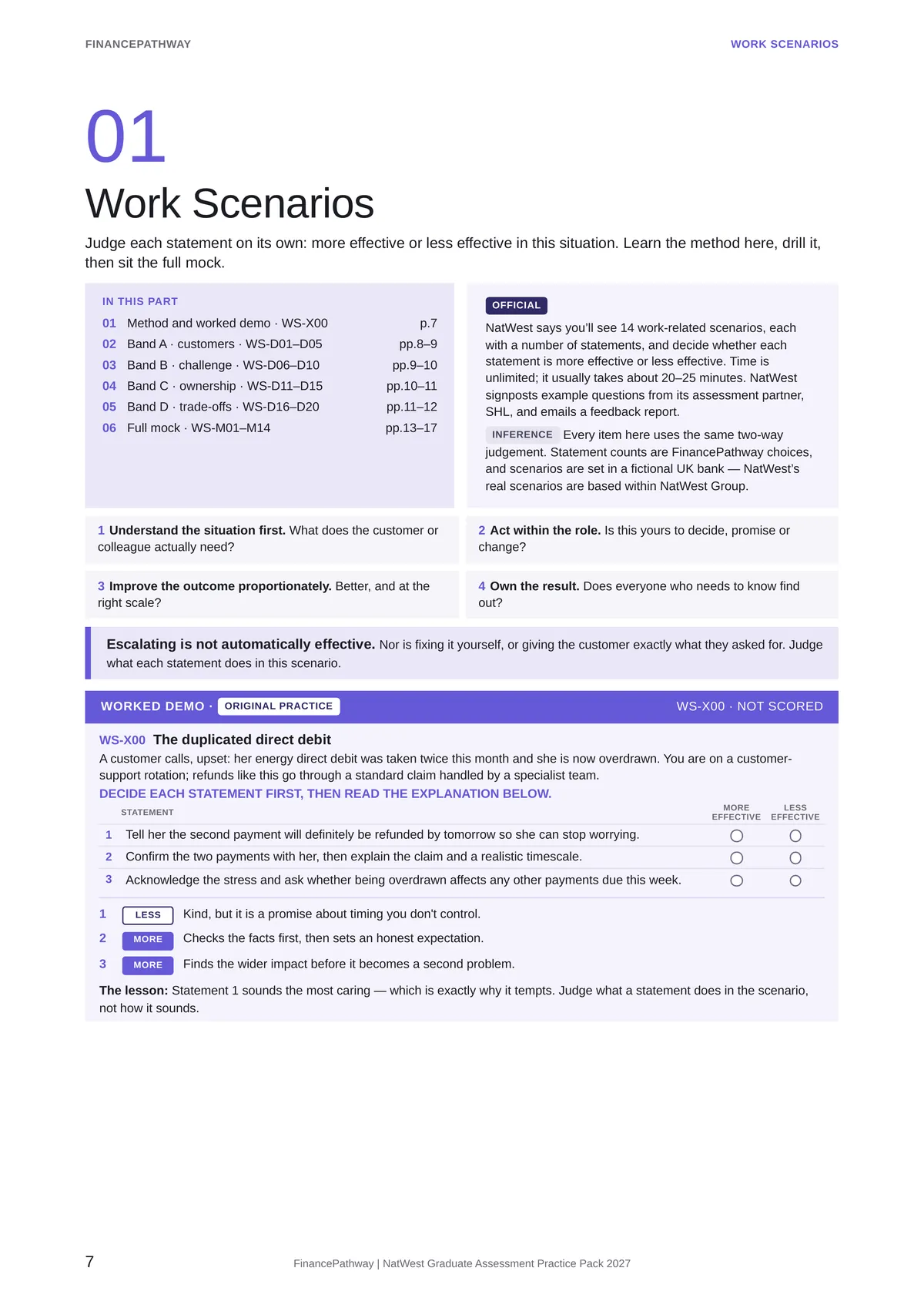

NatWest assessment centre and interview
The Virtual Assessment Centre is the final stage: a full virtual day with breaks. NatWest gives a group discussion, an interactive role play and an interview as examples of the activities, and you receive a personalised feedback report afterwards. NatWest aims to give its decision as soon as possible, and its FAQ says candidates normally hear within a few weeks.
Group discussion
Contribute without dominating. Listen, build on other people's ideas and help move the discussion towards a useful conclusion.
Role play
Respond to another person. Read the brief, clarify what the other person needs, use the evidence to make a reasoned recommendation, then listen, adapt and own the next step.
Interview
Motivation, behaviours and follow-ups. Expect a mixed motivational and behavioural interview, with follow-up questions on your examples, so prepare genuine, recent examples you can discuss in depth.
A full day
Multiple opportunities to demonstrate yourself. Facilitators and assessors guide you through each exercise, with breaks between activities. NatWest doesn't publish start and finish times, the order of exercises or how long each one takes.
One 2026-intake candidate described five activities: a group activity, an interview, a written activity, a customer activity and a manager activity. The customer and manager activities were role plays with an assessor after reading a brief. NatWest's current guidance lists only a group discussion, role play and interview as examples, so treat the written and manager activities as possible rather than confirmed. The same candidate said the day was broadly similar across programmes and tested general ability rather than detailed scheme knowledge. That's a single account, so still prepare for your own programme.
The advice candidates repeat most: include others in the group exercise, explain your reasoning rather than just pushing an answer, and use genuine, recent examples linked to the three behaviours.
When are NatWest assessment centres held?
NatWest doesn't publish assessment centre dates. Candidates report centres running on a rolling basis from late autumn into spring, possibly through May, so an invitation can arrive weeks or months after your video. Two candidates in the 2027 cycle were told that passing the video put them on a shortlist for a limited number of places, so a wait isn't necessarily a rejection.
Invited to the Virtual Assessment Centre? The pack includes two complete practice assessment centres and four six-question video sets, so you can rehearse the group discussion, role play and interview before the day.
NatWest interview questions: what should you prepare?
Expect a mixed motivational and behavioural interview, not a purely strengths-based or competency-based one. NatWest's April 2026 interview guide says interviews can cover your motivation for applying; your knowledge, experience and technical skills, with up to three technical questions depending on the job; all three behaviours; and follow-up questions on your examples. Rather than memorising supposed leaked questions, prepare recent, specific examples you can discuss in depth. The behaviour notes below paraphrase the indicators NatWest publishes.
- Motivation — Why NatWest Group? Build specific reasons connected to the bank, its customers and the programme you are targeting.
- Scheme fit — Why Commercial Banking or CIB? Explain why the clients, work and products of your chosen route appeal to you.
- We start with customers — customer-focused evidence. Good evidence shows curiosity about different customers' needs, sensible use of data and analysis, and pursuing a good outcome for the customer, with empathy, dignity and respect.
- We raise the bar — improvement and challenge. Good evidence shows you speaking up, reflecting and learning, adapting to new information, improving something and taking appropriate risks, and encouraging other people's perspectives.
- We own our impact — ownership and delivery. Good evidence shows tenacity, ownership and integrity, prioritising the work with the most impact, collaborating, and drawing on different skills and perspectives.
- Commercial awareness — What is affecting UK businesses? This is our preparation advice rather than a NatWest promise: its guide says job knowledge may come up but doesn't promise a separate commercial awareness question. Be ready to discuss a current issue and connect it to customer cash flow, investment, financing or risk.
Build technical confidence
Understand how bankers think about company performance, cash flow, leverage and repayment capacity.
Learn credit analysis →Practise a full client case
Apply your commercial and credit thinking to a fictional Commercial Banking lending request.
Try the Commercial Banking case study →When do NatWest graduate applications open and close?
NatWest's 2027 Commercial Banking and Corporate & Institutional Banking programmes opened in late September 2026 and were live by 29 September. NatWest doesn't publish the exact opening date. When we checked Commercial Banking was still open, but Corporate & Institutional Banking had closed for 2027 entry.
Commercial Banking
Open for 2027 entry Birmingham · Bristol · Edinburgh · London · Manchester£37,500 starting salary. When we checked on 29 September 2026, the London vacancy listed an additional £3,450 location allowance.
View Commercial Banking roles →Corporate & Institutional Banking
Closed for 2027 entry London · £60,000 starting salaryNatWest's programme page showed applications as closed on 9 October 2026.
View the CIB programme page →Different streams can also close at different times. For the 2025 intake, archived third-party listings show one Commercial Banking Relationship Management listing closing on 17 October 2024 and another Commercial Banking stream on 6 November 2024. If Commercial Banking is right for you, don't leave your application late.
How to prepare for NatWest in seven days
The best time to prepare is before you begin the live assessment process. Use the week to understand the programme, build your examples and practise making clear decisions under unfamiliar conditions.
Your ticks are saved in this browser only. No account needed.
- Day 1
Understand Commercial Banking versus Corporate & Institutional Banking before submitting your application.
- Day 2
Learn the bank's current behaviours and prepare several examples covering customer focus, improvement, ownership, teamwork and adaptability.
- Day 3
Work through percentages, ratios, trends and business information. Focus on what the numbers mean rather than calculation speed alone. Review credit analysis →
- Day 4
Work through situations involving customers, colleagues, incomplete information, priorities and risk.
- Day 5
Practise NatWest motivation, recent behavioural examples and hypothetical situations without reading from a script.
- Day 6
Rehearse a group discussion, role-play conversation and interview answers linked to NatWest's behaviours. Practise interview questions →
- Day 7
Combine workplace judgement, data interpretation, a commercial recommendation and a recorded response. Try a Commercial Banking case study →
NatWest graduate scheme FAQs
Key questions about NatWest graduate jobs, salaries, locations, applications and assessments.
Is the NatWest graduate scheme 2027 open?
Commercial Banking is, but Corporate & Institutional Banking isn't. When we checked Commercial Banking Relationship Management was still open, while CIB had closed for 2027 entry. NatWest closes each programme once it has enough applications to fill the cohort, so Commercial Banking can close at short notice too. Check the current status before you apply.
When do NatWest graduate applications close?
There's no fixed closing date. NatWest keeps each programme open until it has enough applications to fill the cohort. The 2027 Commercial Banking and CIB programmes opened in late September 2026; CIB had closed by 9 October, while Commercial Banking stayed open longer. In the previous cycle, archived third-party listings show different Commercial Banking streams closing on 17 October and 6 November 2024.
How many stages are there in the NatWest graduate application process?
Five, before an offer: the application, Work Scenarios, the Online Skills assessment, a video recording and a Virtual Assessment Centre, which is the final stage. NatWest's own process diagram counts receiving an offer as a sixth step. Engineering follows a different route that adds SQL and coding tests. See the application process.
How long does NatWest take to get back to you?
It varies, and NatWest publishes no fixed timescales. It processes applications on a rolling basis, and its FAQ says candidates normally hear within a few weeks of the assessment centre. The whole process can take months: one 2026-intake candidate applied in October, attended the assessment centre on 3 February and received an offer in late March. Others they knew received offers between January and May.
When does the NatWest graduate scheme start?
In September 2027. NatWest's programme pages give the month rather than one exact start date for every programme. Commercial Banking and Corporate & Institutional Banking last two years, Finance lasts three, and NatWest Markets roles are permanent rather than a fixed-length programme.
Do I need a CV?
NatWest's current Early Talent application process asks candidates to upload a CV as part of the application.
Do I need a 2:1 for the NatWest graduate scheme?
The current Commercial Banking and Corporate & Institutional Banking graduate programmes require candidates to have, or be on course to achieve, a 2:1 degree.
Do I need a finance degree?
The programme information specifies the required degree classification rather than a finance-specific degree. Check the individual live vacancy for the final eligibility requirements applying to your application.
Can I apply to more than one NatWest graduate programme?
NatWest says it can only accept your first graduate programme application and instructs candidates to apply for one programme in one location.
Where are the 2027 NatWest graduate programmes based?
Commercial Banking Relationship Management graduate roles are based in Birmingham, Bristol, Edinburgh, London and Manchester, and Corporate & Institutional Banking is London-based. Other programmes have their own locations: RBS International, for example, is in Jersey. Because NatWest accepts only one application in one location, check the location in the vacancy before you apply.
Does NatWest sponsor visas, and can I apply on a Graduate visa?
It depends on the programme. NatWest says not all graduate programmes offer Skilled Worker sponsorship, and it sponsors only where there's a business need and the role meets the visa criteria. The current Finance and Economic Crime vacancies say sponsorship isn't offered. NatWest doesn't say whether Graduate visa holders can apply, so check the right-to-work and sponsorship wording in the specific vacancy.
Should I apply for Commercial Banking or Corporate & Institutional Banking?
Choose the one whose clients and work suit you, because NatWest accepts only one graduate application. Commercial Banking is relationship-led banking for businesses, from entrepreneurial firms to major companies. CIB works with larger, more complex corporate and institutional clients on financing, credit, product and risk. CIB has already closed for 2027 entry, but that doesn't mean it's harder to get into. Compare the two routes.
What's the difference between business, commercial and corporate banking?
Mainly the size and complexity of the customer. NatWest's business banking products serve smaller businesses. Commercial Banking provides relationship-led support from entrepreneurial firms through to major companies. Corporate & Institutional Banking focuses on larger, more complex corporate and institutional clients with bigger financing, capital, credit and risk needs. NatWest doesn't publish fixed turnover boundaries between them. Read our corporate vs commercial banking guide.
How competitive is the NatWest graduate scheme?
NatWest doesn't publish applications per place or acceptance rates, so treat any figure you see elsewhere as a guess. What's clear is that demand fills cohorts quickly: Corporate & Institutional Banking had closed by 9 October this cycle, within about two weeks of opening. That doesn't show CIB is harder to get into than Commercial Banking, because NatWest doesn't publish cohort sizes or application numbers.
Do NatWest summer interns get a fast track?
Not a fast track as such, but there's a direct route. NatWest's 2026 Commercial Banking Relationship Management internship listing said interns are assessed at the end of the placement, and successful interns can be offered a place on the graduate programme. That's a conversion route, not a shortcut through the graduate assessment centre. Separately, NatWest's Insight Experience offers eligible participants fast-tracked access to later assessment stages.
What other graduate schemes does NatWest offer?
For 2027, NatWest's graduate programme families are Commercial Banking, Corporate & Institutional Banking, Data Science, Economic Crime, Engineering, Finance, NatWest Markets, Private Banking & Wealth Management, RBS International and Risk. Financing Solutions and Digital Transformation are no longer separate programmes. Published UK salaries range from £37,500 to £70,000. Compare the other programmes.
Is the NatWest graduate scheme the same as the RBS graduate scheme?
Usually, yes. NatWest Group was called The Royal Bank of Scotland Group until 22 July 2020, so older references to an “RBS graduate scheme” usually mean today's NatWest Group programmes. Royal Bank of Scotland is still a brand within the group, and RBS International is a separate graduate programme today, based in Jersey.
What is the NatWest candidate assessment?
It's a loose name for NatWest's online assessments, not an official stage. NatWest's current names are Work Scenarios and the Online Skills assessment. NatWest directs Work Scenarios candidates to an SHL situational judgement practice test, but it doesn't say that every part of Online Skills is a named SHL test, so be wary of prep sites that list specific ones. See the online assessment.
What is the NatWest Work Scenarios assessment?
It's the first online assessment: 14 workplace scenarios, each with statements you mark as more or less effective. It isn't time-limited and usually takes 20–25 minutes. NatWest links an unscored SHL practice test that you can take only once, so use it when you're ready rather than as a warm-up. NatWest emails you a feedback report after the real assessment.
What is the NatWest Online Skills assessment?
It's the second online assessment, which some invitations, older guides and prep sites still call Job Focus. You choose statements that best describe you, rate your preferences, analyse information and solve problems. It takes around 30–35 minutes, most sections are untimed and example items come before the real tasks. Have a pen, paper and calculator ready. There's no personalised feedback for this stage.
How long do I have to complete the NatWest online assessments, and are they timed?
You have 10 days from submitting your application to complete them in full, and NatWest sends a reminder on day 7. Neither has one overall countdown. Work Scenarios has no time limit and usually takes 20–25 minutes. Online Skills takes around 30–35 minutes, and most of its sections are untimed.
What questions are in the NatWest online assessment?
Work Scenarios asks you to judge how effective different responses to 14 workplace situations would be. Online Skills mixes statements and preference ratings about how you work with tasks that involve analysing information and solving problems. NatWest doesn't publish a question count for Online Skills. Earlier candidates described numerical and logical reasoning elements, but NatWest no longer describes separate numerical, deductive or inductive tests.
How do I pass the NatWest online assessment?
There's no published pass mark, so focus on preparation rather than a target score. Use NatWest's example items and the SHL practice test, learn the three behaviours, answer the statement and preference items honestly, and practise working through unfamiliar data and problems calmly. Leave enough of your 10-day window to finish without rushing. Try the free practice questions.
What happens in the NatWest video interview?
You record answers to six questions, taking around 20 minutes. A pre-recorded NatWest colleague presents each question, which is also shown on screen, and there's no live interviewer. Questions cover your motivation, your experience and hypothetical workplace situations. A practice question lets you check your camera and microphone first. Candidates in the 2026 and 2027 cycles report two minutes per answer. The outcome is emailed, without personalised feedback.
How should I answer “Why NatWest?”
Give one specific reason for NatWest and one for your programme, and back each with your own evidence. Link your reasons to something real, such as NatWest's business customers or one of its three behaviours, rather than general points about size or training. NatWest's own preparation advice stresses understanding why you want to join. See what to prepare for interviews.
What are NatWest's values and behaviours?
NatWest now uses three behaviours: We start with customers, We raise the bar and We own our impact. According to NatWest's 2025 Annual Report, they replaced the previous five values (Inclusive, Curious, Robust, Sustainable and Ambitious), which still appear on older pages. Prepare your examples against the three behaviours, not the old values. See what good evidence looks like.
Can I use AI to prepare for a NatWest interview?
NatWest's interview guidance says AI can be used during preparation and research, but candidates should not rely on AI to generate their personal examples or use it during the actual interview.
What happens at the NatWest assessment centre?
It's the final stage: a full virtual day with breaks. NatWest gives a group discussion, an interactive role play and an interview as examples of the activities. Facilitators and assessors guide you through each exercise, and you can discuss adjustments on the day. You receive a personalised feedback report afterwards, and NatWest says candidates normally hear the decision within a few weeks. See the assessment centre.
When is the NatWest assessment centre, and how long is it?
It lasts a full day with breaks, but NatWest doesn't publish dates, start and finish times or how long each exercise takes. Candidates report centres running on a rolling basis from late autumn into spring, possibly through May. Two candidates in the 2027 cycle were told that passing the video put them on a shortlist for a limited number of places, so an invitation can take time.
Can I request reasonable adjustments?
Yes. NatWest says candidates can discuss adjustment needs with its Early Talent team during the recruitment process.
What is the NatWest graduate scheme salary?
NatWest advertises £37,500 for Commercial Banking Relationship Management. When we checked on 29 September 2026, the London vacancy listed an additional £3,450 location allowance. Corporate & Institutional Banking pays £60,000. Across all programmes, the highest published graduate salary is £70,000 for NatWest Markets UK Quantitative Analyst, with CIB and NatWest Markets UK Front Office next at £60,000.
What happens after the NatWest graduate programme?
It depends on the programme, and NatWest says it works with graduates to find a suitable role at the end. CIB graduates can progress to Associate roles across Customer Coverage, Product and Sustainable Finance. NatWest says previous Commercial Banking graduates have moved into roles including Assistant Relationship Director, Portfolio Manager, Relationship Manager and Product Owner. Data Science develops graduates into Data Scientists.
FinancePathway is an independent careers resource and is not affiliated with or endorsed by NatWest Group. Our practice packs do not contain leaked or live NatWest assessment questions. Programme details, salaries, application availability, locations and recruitment stages can change. Always check your live NatWest vacancy and candidate invitation before applying.