Lloyds Graduate Scheme 2027: Commercial Banking Application Guide
Commercial banking is about understanding businesses, building relationships and making decisions about how they grow. This guide helps you choose your Lloyds route and prepare for each application stage. Then try 10 free practice questions, with instant answers.
Try 10 free practice questions
Lloyds graduate schemes at a glance
For commercial and corporate banking applicants, the two relevant Lloyds Banking Group routes are compared below. Figures reflect the recruitment information checked on 7 October 2026.
| Programme | Business & Commercial Banking | Corporate Banking & Markets |
|---|---|---|
| Salary | £45,000 + benefits | £55,000 + benefits |
| Duration | 2 years | 2.5 years |
| Applications close | 11 October 2026 (can close early) | Closed on 4 October 2026 |
| Degree requirement | Degree required; Lloyds says ideally 2:2+ | Degree required; Lloyds says ideally 2:2+ |
| Visa sponsorship | Not available | Not available |
| Location | UK regional rotations; relocation may be required | London-based, with other hub options |
On smaller screens, swipe across the table to compare both routes.
Programme descriptions, locations and official links
Business & Commercial Banking Graduate Scheme
A two-year rotational programme focused on helping UK businesses grow, manage risk and access banking products such as lending, foreign exchange, payments and merchant services.
The Business & Commercial Banking programme includes the Global Credit Certification.
Rotations can take place across Birmingham, Bristol, Edinburgh, Glasgow, Leeds, London and Manchester. Lloyds says graduates spend their first year in one location but may need to relocate for year two.
View the official scheme →Corporate Banking & Markets Graduate Scheme
A 2.5-year programme working with major corporate and institutional clients, including exposure to Coverage, Risk and Product teams and areas such as transaction banking, debt financing and risk management.
Lloyds says the programme is London-based, with options to work from other key hubs including Birmingham and Edinburgh plus other strategic locations.
View the official scheme →Other Lloyds graduate schemes
Lloyds runs several other graduate schemes alongside its banking routes. You can make only one Lloyds graduate application a year, so choose the route that fits you best.
- Risk: £42,000 + benefits
- Accounting & Business Insights: £42,000 + benefits
- Data Science & AI: £48,500 + benefits
- Software Engineer: £48,500 + benefits
- Cyber: £48,500 + benefits
Accounting & Business Insights is Lloyds' current finance-focused graduate scheme.
The Data Science & AI, Software Engineer and Cyber schemes take a longer technical online assessment instead of the standard one: 120 minutes for Data Science & AI, and 130 minutes for Software Engineer and Cyber. Their assessment day also adds a technical exercise.
Closing dates differ by scheme and, for some schemes, by location. Compare all Lloyds graduate schemes →
Still at university? Summer internships
The currently listed Business & Commercial Banking internship is closed for applications, so check the official undergraduate pages for the next recruitment cycle.
Business & Commercial Banking versus Corporate Banking & Markets
Do not choose between these schemes based only on salary. The customer base, products, technical depth and day-to-day work differ substantially.
Business & Commercial Banking
Lloyds says graduates work directly with Business & Commercial clients, learn what customers need, build long-term relationships and gain exposure to products including lending, foreign exchange, payments and merchant services.
The programme also includes exposure to risk, including credit underwriting and conduct controls.
This route is likely to suit candidates interested in understanding companies, building client relationships and helping businesses solve financing and banking problems.
Corporate Banking & Markets
Lloyds says this business serves major corporate and institutional clients with strong UK connections, generally including companies with turnover above £100 million.
Graduates rotate through areas including Coverage, Risk and Product, with exposure to transaction banking, debt financing, risk management and capital-markets-related activity.
This route is closer to large-cap corporate banking and wholesale markets activity than traditional mid-market Commercial Banking.
Lloyds graduate scheme application process
Lloyds Banking Group currently uses a three-stage graduate selection process for its standard graduate programmes. One useful difference from many graduate applications is that Lloyds does not require a CV or covering letter. Lloyds also accepts only one graduate programme application per candidate per year.
-
Application form and online assessment
Register and complete the application form with basic information about yourself. Lloyds says a CV and cover letter are not required. You then complete its online assessment, which should take around 60 minutes.
-
Job Insight Assessment
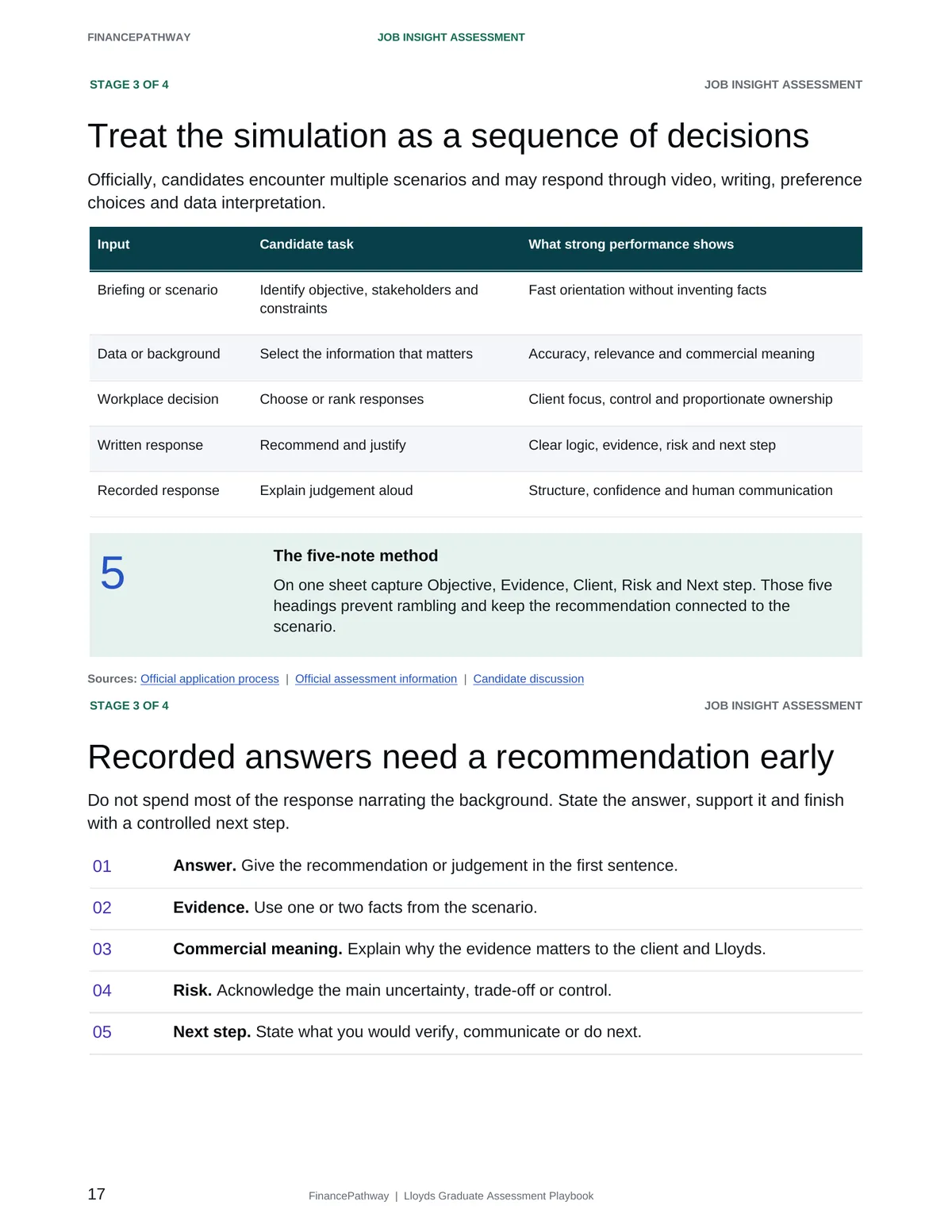
Successful candidates move to a role-relevant assessment using multiple scenarios. Lloyds confirms that this includes data for analysis and interpretation plus video responses, written responses and preference-indication questions.
-
Assessment centre
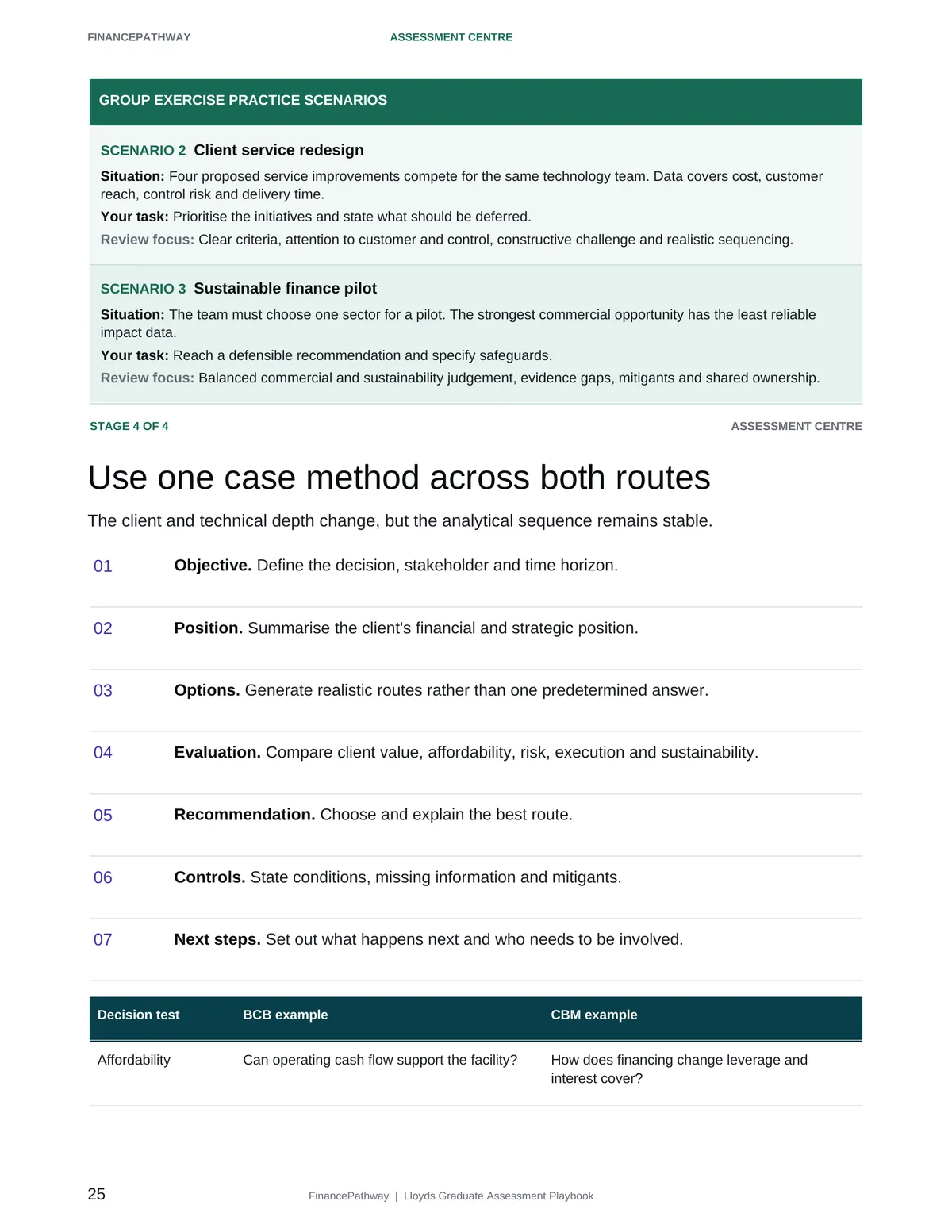
The final stage includes pre-work followed by exercises such as a one-to-one interview, group exercise and individual assessments linked to the pre-work. Assessment centres may be virtual or in person depending on the programme.
Lloyds online assessment
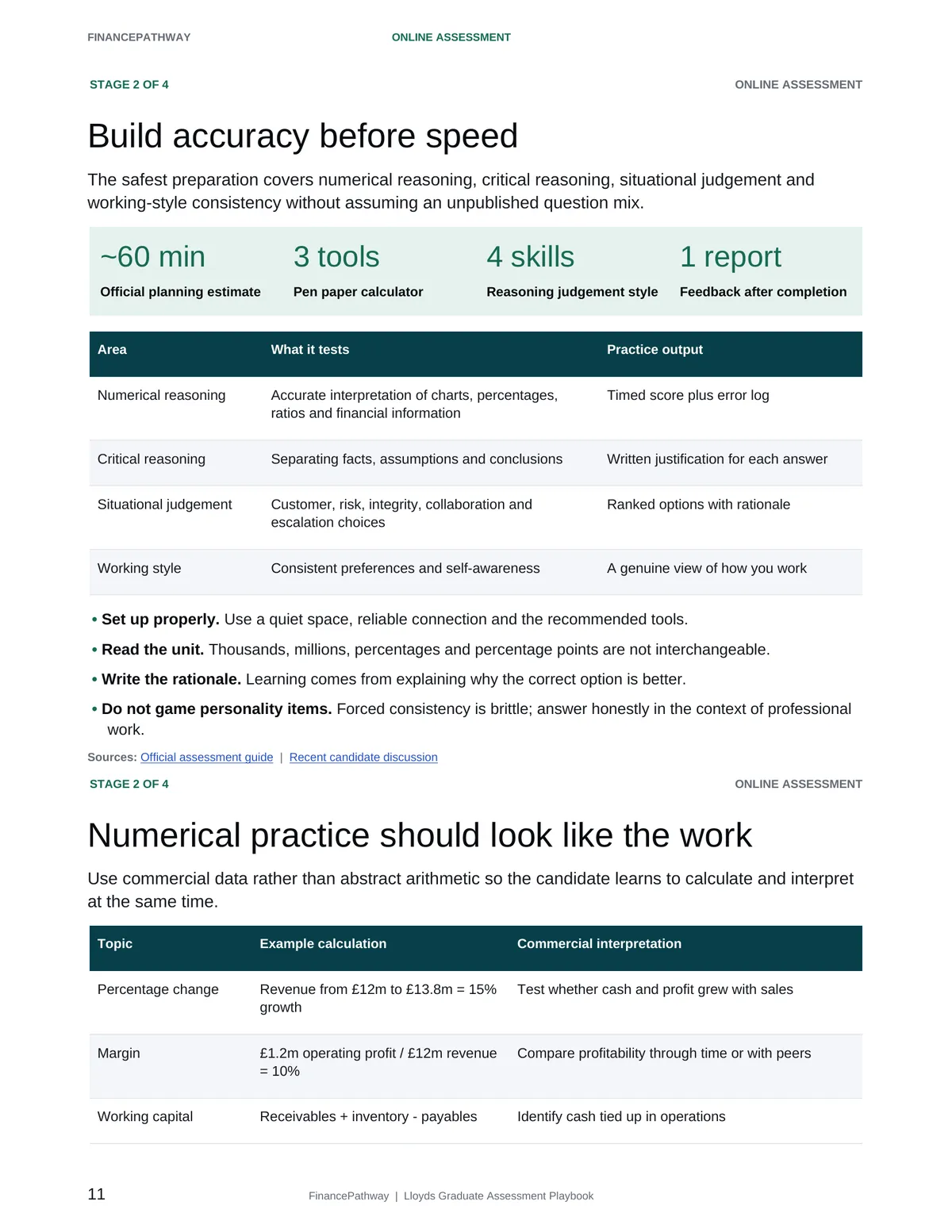
Lloyds says its standard graduate online assessment should take around 60 minutes. It is designed to introduce candidates to the Group and how it supports customers and communities while assessing how they approach workplace situations.
What Lloyds currently confirms
- Around 60 minutes — Lloyds recommends setting aside around an hour in a quiet environment without distractions. It doesn't publish a hard time limit, so follow the instructions in your invitation.
- Calculator recommended — Lloyds explicitly recommends having a pen, paper and calculator available before beginning.
- Work and customer context — The assessment is designed to give candidates insight into the Group and how it supports customers and communities.
- Accessibility features — Lloyds confirms captions for audio, keyboard navigation, minimum question-text sizing and zoom support.
- Feedback, not scores — Lloyds says you receive an Insights feedback report within a few days, rather than individual scores. It doesn't publish a pass mark or how different components are weighted.
- Complete before deadline — Lloyds says both the application form and online assessment must be completed before the scheme closes.
Practise connecting the numbers to the business. In a fictional example, sales are rising but cash is running short. Before reaching a conclusion, check whether customers are taking longer to pay, more cash is tied up in stock, or costs are squeezing margins. The useful habit is to explain what you would check and why—not jump straight to a lending decision.
Start with the official Lloyds Candidate Support Hub for assessment previews and preparation tips. Lloyds' FAQs call the same site the Assessment Practice Zone. You'll need to register to use its practice material.
Taking the online assessment before Business & Commercial Banking closes on 11 October? Practise first with the Lloyds Practice Pack: original numerical, workplace-judgement and spoken-response questions set in banking scenarios, each with worked guidance.
How to prepare for the online assessment
Practise, then review your reasoning
Try the free practice questions and compare your reasoning with the worked guidance. They are original FinancePathway questions, not actual Lloyds assessment questions.
Avoid memorised answer patterns
Lloyds explicitly says it wants candidates to be themselves rather than deliver perfectly performed answers.
Preparation should therefore improve the quality of your reasoning, not teach you to imitate supposed leaked answers.
Lloyds Job Insight Assessment
This stage explores role-related scenarios, information and decisions. When practising a response, state your recommendation, support it with the relevant evidence, identify a risk and explain what you would check next. This is a preparation framework, not an official scoring rubric.
- Workplace judgement — Lloyds says multiple scenarios explore how candidates would respond to situations linked to the role.
- Analysis and interpretation — Candidates may need to work with information and data before reaching a conclusion or deciding how to respond.
- Video, written and preference — Lloyds explicitly confirms video responses, written responses and preference-indication questions, including timed or time-recorded elements.
Invited to the Job Insight Assessment? The Lloyds Practice Pack includes written and spoken-response prompts built around banking scenarios, with scoring guides so you can review your own answers before the real thing.
Free Lloyds online assessment practice questions
Numerical, judgement, written and spoken-response questions in the style of the Lloyds assessments, with instant feedback on every answer.
Original FinancePathway questions, not real or recalled Lloyds questions.
Start the free sample
- Question 1
- Question 2
- Question 3
- Question 4
- Question 5
- Question 6
- Question 7
- Question 8
- Question 9
- Question 10
How did gross margin change?
Harlow & Pike Foodservice Ltd is a fictional UK food wholesaler. Margins are expressed as a percentage of revenue.
| £000 | FY2024 | FY2026 |
|---|---|---|
| Revenue | 18,400 | 23,700 |
| Gross profit | 4,600 | 5,450 |
By how much did gross margin change between FY2024 and FY2026?
Gross margin fell from 25.0% to 23.0%, a change of -2.0 percentage points.
See the working
Working: FY2024 gross margin = 4,600 / 18,400 = 25.0%. FY2026 gross margin = 5,450 / 23,700 = 23.0%. The change is 23.0% - 25.0% = -2.0 percentage points.
Commercial meaning: each point of gross margin on £23.7m of revenue is worth about £237k, so pricing or input costs deserve investigation.
Common trap: confusing percentage points with percentage change.
The figure that does not match
Your manager's credit paper states a client's net debt/EBITDA as 2.1x. Your own workings show 3.1x. The paper goes to credit committee tomorrow.
Check your own numbers first, then raise it privately with your manager while there is still time to fix it.
See the working
It combines analytical rigour with respectful, timely challenge: verify your work first, then raise the discrepancy directly while there is still time to correct it.
Full ranking: A, D, B, C. Raising it tomorrow is later and more public; bypassing your manager is premature; ignoring a possible 1.0x leverage error could mislead a credit decision.
Tests: speaking up, accuracy and constructive challenge.
A client's revenue grew 20%, but its overdraft use doubled. What might be happening?
Prepare a short answer, then say it aloud in 60 seconds. Lead with your interpretation, explain two plausible causes and finish with what you would check next.
A strong answer would include
- Revenue growth does not automatically mean stronger cash generation.
- Possible causes such as slower customer collections, inventory build, tighter margins or capital spending funded from the overdraft.
- The evidence you would check: debtor days, inventory days, creditor days, gross margin, cash-flow movements and the purpose of recent payments.
- A proportionate next step rather than an immediate credit conclusion.
Score yourself out of 4: give yourself one point for each: a clear opening interpretation; two plausible causes; specific evidence to check; and a next step delivered within 60 seconds. This is a practice checklist, not a Lloyds scoring system.
Unlock seven more questions, free
Email sign-up is not available at the moment.
Admin note (only visible when logged in): add the Hostinger Reach widget with the CSS class fp-sample-gate-form below this HTML widget.
We'll email you a link back to the questions and a few short Lloyds prep emails, which mention our practice packs. Unsubscribe any time. Privacy policy
Questions 4 to 10 are unlocked
We have also emailed you a link so you can come back to them. If it has not arrived within a few minutes, check your promotions or spam folder.
How did debtor days change?
Brennick Packaging Ltd is a fictional UK packaging manufacturer. Use a 365-day year.
| £000 | FY2025 | FY2026 |
|---|---|---|
| Revenue | 10,400 | 12,000 |
| Trade receivables | 1,600 | 2,300 |
By how much did debtor days change between FY2025 and FY2026?
Debtor days rose from 56.2 to 70.0, so customers are taking about 13.8 days longer to pay.
See the working
Working: FY2025 debtor days = 1,600 / 10,400 × 365 = 56.2 days. FY2026 debtor days = 2,300 / 12,000 × 365 = 70.0 days. The change is 70.0 - 56.2 = +13.8 days.
Commercial meaning: at FY2026 revenue, one day of sales is worth about £32.9k, so customers paying 13.8 days more slowly ties up roughly £454k of extra cash. This is exactly how a growing business ends up leaning on its overdraft.
Common trap: +43.8% is the growth in receivables. Receivables have to be compared with revenue to show how quickly customers pay.
How much covenant headroom is there?
Oakmere Joinery Ltd is a fictional UK joinery business. Its loan agreement requires net debt/EBITDA to stay at or below 3.5x. Net debt is £6.3m and EBITDA is £2.1m.
Assuming net debt stays the same, by what percentage could EBITDA fall before the covenant is breached?
EBITDA can fall from £2.1m to £1.8m before leverage hits 3.5x, a fall of 14.3%.
See the working
Working: current leverage = 6.3 / 2.1 = 3.0x. The covenant is breached once EBITDA falls below 6.3 / 3.5 = £1.8m. That is a fall of £0.3m, and 0.3 / 2.1 = 14.3%.
Commercial meaning: 0.5x of headroom sounds comfortable, but losing one large contract could use it up. A relationship manager would look at the forecast, customer concentration and how quickly costs could be cut.
Common trap: 16.7% is the leverage headroom as a share of 3.0x (0.5 / 3.0), not the EBITDA headroom. The two are not the same.
Which statement does the lending data support?
A fictional regional commercial banking team recorded these lending applications over one quarter.
| Sector | Applications | Approved | Average approved loan (£000) |
|---|---|---|---|
| Manufacturing | 48 | 36 | 420 |
| Hospitality | 30 | 15 | 180 |
| Professional services | 42 | 35 | 250 |
Which statement is supported by the data?
Manufacturing's £15.12m is 56.9% of the £26.57m of lending approved in total.
See the working
Working: approved lending is £15.12m for manufacturing (36 × £420k), £2.70m for hospitality (15 × £180k) and £8.75m for professional services (35 × £250k). The total is £26.57m, so manufacturing's share is 56.9%.
Why the others fail: A is half right, since professional services had the highest approval rate (83.3%) but not the largest value. B is wrong because 50% is 60% of 83.3%, not half. D is wrong because 86 of 120 applications were approved, which is 71.7%.
Common trap: the sector with the best approval rate is not necessarily where most of the bank's lending sits.
The client who needs an answer by Friday
The owner of Tolland Freight Ltd, a long-standing fictional client, calls on Tuesday. A supplier needs to know by Friday whether the business can fund a large order, so the owner asks you to confirm today that a £250k loan increase will be approved. The latest management accounts have not been provided, and the lending decision sits with credit, not with you.
Be honest about what you can promise, set out what is needed, and tell your manager about the deadline today.
See the working
It is honest about what you can promise, gives the client a practical route to a decision, and makes sure the person who can help with timing knows about the deadline today rather than on Thursday.
Full ranking: B, C, D, A. C is honest but leaves the client without a path forward. D looks helpful, but an incomplete application is more likely to be delayed or declined. A gives an assurance you cannot give, which creates conduct risk and could damage the client if the loan is not approved.
Tests: customer focus, integrity and managing expectations under pressure.
The teammate who has gone quiet
You and two other graduates are presenting a sector review to senior colleagues on Thursday. It is Tuesday afternoon. One teammate has not started their section and missed this morning's check-in. You have some spare capacity, but not enough to write their whole section well.
Talk to your teammate directly and early, and agree a specific plan well before Thursday.
See the working
It deals with the problem early and directly, gives the teammate a chance to explain, and turns your spare capacity into a specific plan rather than a rescue.
Full ranking: A, C, B, D. C is reasonable if a direct conversation fails, but escalating first damages trust. B risks duplicated work and a section you cannot present with confidence. D leaves too little time to recover.
Tests: teamwork, ownership and constructive challenge.
Should we progress this loan application?
Larchfield Dental Group Ltd, a fictional client, runs six dental practices and has asked for a £400k loan to open a seventh.
| Revenue growth, last 12 months | +9% |
| EBITDA margin | 21% |
| Net debt/EBITDA after the new loan | 2.4x |
| Recent change | One practice lost its lead dentist last month. A replacement has not yet been recruited. |
Write a note of no more than 120 words to your manager recommending whether to progress the application. Include one risk and one thing you would check.
A strong note would include
- A clear recommendation in the first sentence.
- At least two pieces of supporting evidence from the table, such as growth, margin or leverage.
- A relevant risk, such as dependence on clinicians at the affected practice or the cost of opening a new site.
- A specific check, such as practice-level revenue or the recruitment plan and timescale for a replacement.
Example answer (93 words): I recommend we progress the application, subject to one check. Revenue grew 9% last year, the 21% EBITDA margin is healthy and leverage after the loan would be a moderate 2.4x. The main risk is staffing: one practice lost its lead dentist last month, and dental revenue depends heavily on clinicians. Before submitting to credit, I would ask for practice-level revenue to see how much that dentist generated, and for the plan and timescale for a replacement. If the impact is material, we could reflect it in the forecasts or the loan structure.
Score yourself out of 4, one point for each item above, and take a point off if you went over 120 words. This is a practice checklist, not a Lloyds scoring system.
If the Bank of England base rate fell by 0.5 percentage points, how might that affect a manufacturing client with a £5m variable-rate loan?
Prepare a short answer, then say it aloud in 60 seconds. Start with the direct effect, then cover at least one wider effect and say what you would discuss with the client.
A strong answer would include
- The direct effect, with a number: interest costs fall by about £25k a year (£5m × 0.5%), assuming the margin over base rate is unchanged and the loan is not hedged.
- What that means for the business: better cash flow and interest cover, and possibly more room to invest.
- At least one wider effect, such as customer demand, sterling or the client's own suppliers and competitors.
- What you would check or discuss: whether the loan is hedged with a swap or cap, the loan terms, and the client's investment plans.
Score yourself out of 4: give yourself one point for each item above, delivered within 60 seconds. This is a practice checklist, not a Lloyds scoring system.
Take a look inside
Three real pages from the pack. Tap a page to read.
Lloyds assessment centre and interview
The assessment centre is the final stage of Lloyds' graduate process. Plan for a full day: you receive pre-work in advance, then complete a one-to-one interview, a group exercise and individual assessments linked to the pre-work. Lloyds says the day also includes chances to learn about its culture and talk to current graduates. It lists no technical exercise for Business & Commercial Banking or Corporate Banking & Markets; the Data Science & AI, Software Engineer and Cyber schemes add one.
Prepare before the day
Lloyds confirms that candidates receive pre-work before the assessment centre, with full instructions supplied in advance.
Lloyds doesn't publish the pre-work topic or format, so be wary of any site claiming to know this year's case. Focus on understanding the material once it arrives.
One-to-one interview
The one-to-one interview takes place within the assessment centre. Lloyds' published process has no separate final interview afterwards.
Prepare clear reasons for Lloyds Banking Group, the scheme you selected and why the type of banking work appeals to you.
Work effectively with others
A group exercise is part of the officially described process. You need to contribute without dominating and help the group reach a practical outcome.
Good performance is about listening, reasoning and moving the discussion forward — not simply speaking the most.
Apply your judgement
Lloyds also confirms individual assessments relating to the pre-work candidates completed before the assessment centre.
Be prepared to explain how you reached your conclusion rather than simply giving a final answer.
When is the assessment centre, and what happens next?
Lloyds doesn't publish assessment centre dates or a timescale for offers. Candidates report invitations going out in batches, so hearing later than other applicants isn't a sign you've been rejected.
For a rough idea of timing, one candidate last cycle completed the Job Insight Assessment on 21 October and was offered assessment centre dates of 26 November or 11 December.
If you're successful, the offer follows the assessment centre, then pre-employment checks.
Invited to the assessment centre? The Lloyds Practice Pack includes assessment-centre practice and original route-specific banking cases, all with worked guidance. Use them to practise analysing a business and explaining your reasoning before the day.
Lloyds interview questions: what to prepare
Lloyds does not publish a bank of exact graduate interview questions. The best preparation is to build strong, adaptable evidence around your motivation, the scheme, your behaviours and the type of commercial judgement the role requires.
Helping Britain Prosper
Lloyds frames its purpose around supporting people, businesses and communities across the UK. For banking candidates, connect this to the real economic role of lending, payments and advice.
Accelerate 2030
Lloyds' next strategy is focused on simpler, smarter and more connected customer experiences, stronger links across the Group and technology-enabled productivity.
Backing UK growth and transition
Lloyds has stated ambitions to provide more than £45 billion for SMEs and £100 billion of sustainable and transition financing as part of its 2030 strategy.
Know the current values
Lloyds' published values are People-first, Bold, Inclusive, Sustainable and Trust. Prepare evidence that shows how your own behaviour aligns naturally with them.
Prepare specific reasons connected to Lloyds' customers, UK presence, strategy or the business area you are targeting.
Be able to explain why client relationships, lending, business analysis and helping UK companies grow appeal to you.
Prepare strong examples covering teamwork, ownership, communication, challenge, adaptability and learning.
Show that you can understand the customer's objective, assess the information available and balance opportunity with risk.
Be ready to discuss a current issue and explain its impact on companies, cash flow, investment or financing needs.
Prepare thoughtful questions about the programme, rotations, clients, development and what strong graduates learn on the job.
When does the Lloyds graduate scheme open?
The 2027 Lloyds Banking Group Business & Commercial Banking and Corporate Banking & Markets graduate schemes opened on 10 September 2026. Corporate Banking & Markets closed on 4 October, and Business & Commercial Banking is scheduled to close on 11 October.
Corporate Banking & Markets
Closed on 4 October 2026 Applications for the 2027 intake have closedHow to prepare for Lloyds in seven days
Finish each day with something concrete to review. This is a suggested practice schedule, not a Lloyds requirement; adapt it to your invitation and deadline.
Your ticks are saved in this browser only. No account needed.
-
Day 1
Write three reasons for your chosen route, each linked to the clients, work and your own interests. Check eligibility and the live vacancy before committing.
-
Day 2
Draft five short examples from your own experience covering teamwork, ownership, challenge, communication and learning. Note your action and the result for each.
-
Day 3
Complete the numerical questions in the free sample. Show your calculation, explain the commercial meaning in one sentence, and note any mistake to revisit.
-
Day 4
Complete the workplace-judgement questions in the free sample. Explain why your choice is stronger than the alternatives, considering accuracy, timing and who needs to be involved.
-
Day 5
Use question 3 or 10 from the free sample. Record a 60-second answer on your own device, review it against the guidance, then repeat it once without reading a script.
-
Day 6
Practise why Lloyds, why your route and two behavioural examples aloud. Prepare two questions to ask and one way to help a group reach a decision.
-
Day 7
Use a fictional business scenario to write a short recommendation and deliver a 60-second explanation. Review your evidence and clarity, then list two priorities for your next session.
Lloyds graduate scheme FAQs
These answers cover the most useful questions about Lloyds Banking Group graduate jobs, eligibility, applications, assessments and locations.
Is the Lloyds graduate scheme 2027 still open?
When did the Lloyds graduate scheme open?
What is the Lloyds graduate scheme salary?
Where are the Lloyds graduate schemes based?
Can I apply to more than one Lloyds graduate programme?
Can I reapply next year?
Do I need a CV for the Lloyds graduate scheme?
How long is the Lloyds online assessment?
Is the Lloyds online assessment timed, and how is it scored?
What is the Lloyds Job Insight Assessment?
How long is the Lloyds Job Insight Assessment?
What happens at the Lloyds assessment centre?
When is the Lloyds assessment centre?
How long is the Lloyds assessment centre?
Is there a final interview after the assessment centre?
What Lloyds interview questions should I prepare for?
How long does it take to hear back from Lloyds?
Does Lloyds sponsor visas for these graduate schemes?
Do I need a 2:1 for the Lloyds graduate scheme?
Do I need a finance degree?
How hard is it to get onto the Lloyds graduate scheme?
Is Lloyds Banking Group the same as Lloyd's of London?
Can I request reasonable adjustments?
FinancePathway is an independent careers resource and is not affiliated with Lloyds Banking Group. Programme details, deadlines, salaries and recruitment stages can change. Always check your live Lloyds Banking Group vacancy and candidate invitation before applying.