Commercial Banking vs Investment Banking: Which Career Should You Choose?
Compare the actual work, salaries, hours, recruitment and exit opportunities—then see how both bankers would approach the same £21 million acquisition.
Contents
What Is the Difference Between Commercial Banking and Investment Banking?
Commercial banking generally puts a bank’s balance sheet to work by lending to businesses and earning interest and fees over time, alongside ongoing services such as payments and foreign exchange. Investment banking focuses more on advising companies on acquisitions, disposals, capital raising and other major transactions, earning advisory and underwriting fees.
As careers, commercial banking centres on credit analysis, lending decisions and long-term client relationships. Investment banking centres more on valuation, financial modelling and transaction execution. That is the practical difference between commercial and investment banks that matters most when choosing a graduate career.
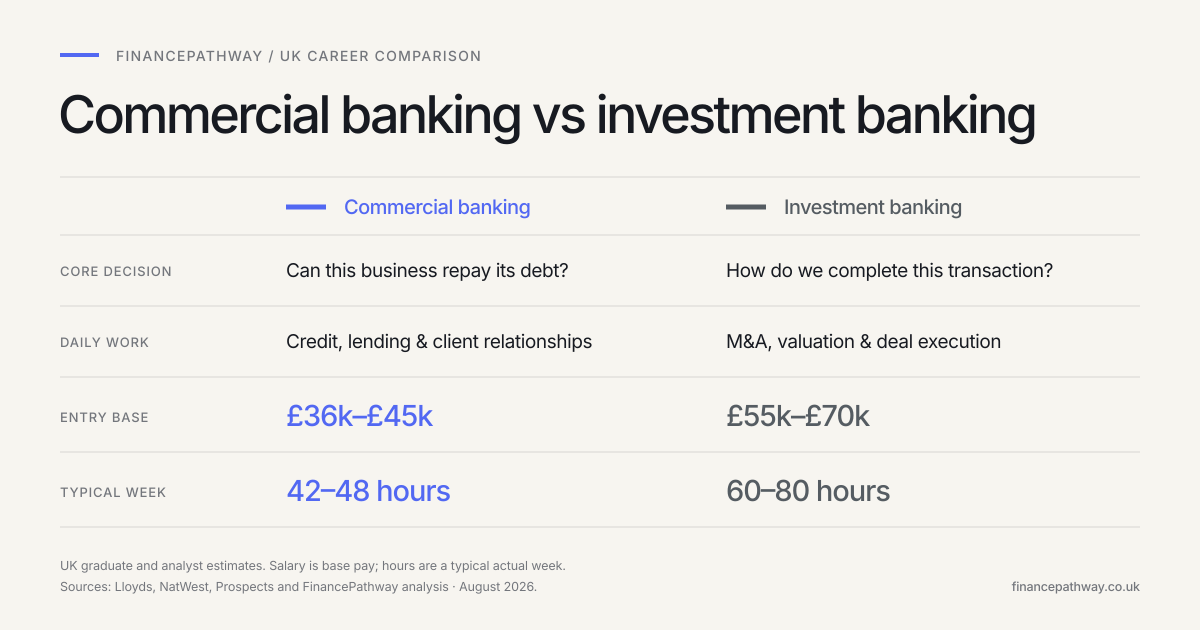
A commercial banker asks, “Will this business repay us?” An investment banker asks, “What transaction should this business pursue, and how do we execute it?”
For a UK graduate, the trade-off is also visible in pay and lifestyle. Commercial banking commonly pays £36,000–£45,000 at entry level and usually involves a working week in the low-to-high 40s. A first-year analyst at a large London investment bank can earn roughly £55,000–£70,000 base, plus a larger and more variable bonus, but 60–80-hour weeks and unpredictable late nights are common.
Investment banking offers higher pay, intensive transaction experience and broader deal-related exits. Commercial banking offers earlier client responsibility, more predictable hours, strong regional opportunities and a career built around credit judgement.
Commercial banking vs investment banking at a glance
The table below summarises the main differences between commercial banks and investment banks from a UK graduate career perspective, including the work, clients, analysis, pay, hours and career fit.
| Area | Commercial banking | Investment banking |
|---|---|---|
| Purpose | Lend money and provide ongoing banking services to businesses | Advise on M&A, capital raising and other major transactions |
| Core analysis | Cash flow, leverage, repayment capacity and downside risk | Valuation, financial modelling, deal structure and execution |
| Typical clients | Established SMEs, privately owned companies and mid-sized businesses | Large companies, private equity firms, institutions and some mid-market businesses |
| Revenue | Interest margin, arrangement fees and product income | Advisory, underwriting and transaction fees |
| Graduate work | Accounts analysis, credit papers, meeting preparation and covenant monitoring | Models, valuations, pitchbooks, market research and process work |
| Entry-level base | Approximately £36,000–£45,000 | Roughly £55,000–£70,000 at many large London banks |
| Typical week | Approximately 42–48 hours | Commonly 60–80 hours, with higher live-deal peaks |
| Locations | London and regional business centres across the UK | Heavily concentrated in London |
| Best fit | Lending judgement, long-term relationships and sustainable hours | Transactions, valuation, intensive execution and maximum early-career earnings |
These are market-level differences, not rules. Acquisition finance can sit closer to investment banking than general relationship management, while a small regional M&A boutique may pay less than a leading commercial-bank graduate scheme.
Commercial Bank vs Investment Bank: What Does Each One Do?
What does a commercial bank do?
In this comparison, a commercial bank provides lending and ongoing banking services to businesses. Commercial bankers analyse accounts and cash flow, assess debt capacity, structure facilities and coordinate products such as payments, asset finance and foreign exchange. If you want the broader business-model explanation, read FinancePathway’s guide to what commercial banking is and how it works.
Commercial banking is not identical to corporate banking. Corporate teams normally serve larger organisations and arrange more complex facilities, although each bank draws the boundary differently. See FinancePathway’s corporate banking vs commercial banking guide for that distinction.
What does an investment bank do?
An investment bank advises companies, financial sponsors and institutions on major transactions. Depending on the team, that can include M&A advice, debt or equity capital raising, valuation, financial modelling and transaction execution. In this article, “investment banking” means front-office M&A, sector coverage and capital-markets work—not every risk, technology or operations role inside an investment-banking division.
Can the Same Bank Offer Commercial and Investment Banking?
Yes. A large banking group can operate commercial, corporate and investment-banking businesses at the same time. The distinction is mainly about the activity and division you are joining, not whether the entire banking group can be labelled as only a “commercial bank” or only an “investment bank”.
That is why two graduates working for the same banking group can have very different jobs: one may analyse lending and manage business relationships, while another builds valuations and executes transactions. For example, HSBC’s careers site lists commercial and investment banking among the group’s different business areas.
Commercial Banking vs Investment Banking: A Real-World Example
Imagine Northfield Components Ltd, a fictional UK manufacturer, wants to acquire a competitor. The commercial-banking team and M&A adviser may work on the same acquisition, but they are making completely different decisions.
Northfield Components buys a competitor
Northfield generates £52 million of revenue and £7.5 million of EBITDA. The target generates £18 million of revenue and £3 million of EBITDA. Northfield’s shareholders can contribute £7 million, leaving a £14 million funding requirement.
What the commercial banker does
- Understand the acquisition rationale and management’s experience.
- Test revenue quality, margins, working capital and cash conversion.
- Calculate leverage: £20 million of pro-forma debt divided by £10.5 million of EBITDA is roughly 1.9x.
- Model a downside where EBITDA falls and working capital absorbs cash.
- Structure the term loan, revolving facility, security and covenants.
- Present the risk, return and mitigants to the bank’s sanctioning authority.
What the investment banker does
- Assess whether the target adds customers, products or capacity.
- Value it using comparable companies, precedent deals and forecast cash flow.
- Build the acquisition model and test synergies, leverage and shareholder returns.
- Advise on price and whether consideration should be deferred or performance-linked.
- Coordinate due diligence, boards, lawyers, accountants, lenders and the seller’s adviser.
At this deal size, Northfield might hire a specialist UK M&A boutique rather than a global investment bank. “Investment banking” covers both multi-billion-pound public-company deals and smaller owner-managed transactions, so always examine the actual firm and team.
What the day-to-day work is really like
Analysis, clients and risk
Graduates review accounts, prepare credit papers, research clients, attend meetings and monitor covenants. The job is not merely sales. Routes include relationship management, credit underwriting, portfolio management and specialist products.
Models, materials and process
M&A analysts value companies, update models, build presentations and manage due diligence. Debt capital markets focuses on bonds, equity capital markets on share issuance, and leveraged finance on acquisition and higher-risk debt.
Lloyds and NatWest both describe commercial-banking graduate work spanning clients, lending, products and risk. If that side of the comparison sounds like the better fit, FinancePathway’s commercial banking careers guide explains the roles, progression and what the work is actually like.
Junior investment-banking work is less glamorous than the deal announcement. Checking numbers, fixing slides and responding to comments consume substantial time. Accuracy and speed are tested constantly.
Commercial Banking vs Investment Banking: Salary and Hours
Investment banking pays materially more, especially once bonuses are included. However, comparisons must separate large London banks from smaller advisory firms.
| Career point | Commercial banking | Investment banking |
|---|---|---|
| Graduate / analyst base | £36,000–£45,000 at leading UK schemes | £55,000–£70,000 at many large London banks |
| Indicative first-year total cash | Roughly £38,000–£50,000 | Often £85,000–£120,000 at large banks, with wide variation |
| Typical working week | 42–48 hours | 60–80 hours; live deals can exceed this |
| Schedule control | Usually reasonable; weekend work is uncommon | Low; late comments can change an evening or weekend |
NatWest’s 2026 Commercial Banking programme publishes a £36,000 salary, while Lloyds publishes £45,000 plus benefits. For investment banking, Prospects gives a broad UK starting range of £40,000–£70,000 and states that working weeks can reach 50–80 hours.
Commercial-banking hours are estimates because employers publish contracted rather than actual weeks. Around 42–48 hours is sensible for many graduate, credit and relationship roles, with 50-plus-hour periods around difficult lending requests or annual reviews. Investment-banking hours are not only longer; they are less controllable because client and senior-banker comments can arrive late.
Read the full UK commercial banking salary guide for bank-by-bank pay, bonuses, benefits and methodology.
Graduate recruitment and interview preparation
Investment banking is harder to enter at major firms, but strong commercial-banking schemes are still selective.
| Factor | Commercial banking | Investment banking |
|---|---|---|
| Main routes | Graduate schemes, internships, credit and assistant-relationship roles | Spring weeks, summer internships, graduate programmes and boutique analyst roles |
| Geography | London plus Birmingham, Bristol, Edinburgh, Glasgow, Leeds, Manchester and other centres | Primarily London, with fewer regional advisory roles |
| Technical focus | Financial statements, cash flow, leverage, credit risk and lending judgement | Accounting, valuation, modelling, transaction mechanics and markets |
| Experience | Analytical, customer and commercial experience can transfer | Relevant internships are particularly valuable at large firms |
For a commercial-banking interview, be ready to explain why profit differs from cash flow, how working capital affects liquidity, what leverage and interest cover show, and how a bank decides whether to lend. Strong answers recognise opportunity but challenge forecasts and consider the downside.
If commercial banking is the direction you want to pursue, the next step is to see which commercial and corporate banking graduate schemes are currently available and how different employers label their programmes.
Investment-banking candidates should know the three statements, enterprise versus equity value, valuation methods, DCF mechanics and acquisition logic. They should also discuss a recent deal and explain why a specific firm, sector or product team appeals to them.
Do not present commercial banking as an investment-banking backup. A credible commercial-banking answer mentions credit judgement, lending and long-term relationships. A credible investment-banking answer focuses on transactions, valuation and execution.
Career progression, exit opportunities and switching routes
A commercial-banking career can progress from graduate or analyst to assistant relationship manager, credit analyst, relationship manager, relationship director and regional or product leadership. Parallel routes exist in credit sanctioning, restructuring, portfolio management and specialist finance.
Investment banking typically progresses from analyst to associate, vice president, director and managing director. The role changes with seniority: analysts execute; senior bankers must win mandates and manage client relationships.
Investment banking usually offers broader transaction-related exits, including corporate development, private equity and other advisory roles. Commercial banking creates strong routes into corporate banking, credit risk, underwriting, debt advisory, treasury and some private-credit roles.
Can you move from commercial banking into investment banking?
Yes, but it is not automatic. The most credible routes are:
- Move toward corporate banking, acquisition finance or sponsor-backed lending.
- Target leveraged finance, debt advisory or restructuring, where credit skills transfer directly.
- Build genuine transaction evidence through acquisitions and refinancings.
- Learn valuation and modelling well enough to apply them under interview pressure.
- Consider a mid-market advisory boutique and accept that seniority may reset.
A direct jump from a general SME relationship role into a top-tier London M&A team is rare. Commercial banking is not an easy back door into private equity either. If M&A execution is the real goal, apply for it directly or deliberately build the intermediate experience.
Is Commercial Banking Better Than Investment Banking?
Neither is inherently better. Commercial banking is usually the better fit if you prefer credit judgement, long-term client relationships and more predictable hours. Investment banking is usually the better fit if you prefer valuation, transactions and intensive execution and are comfortable accepting less control over your schedule in exchange for higher early-career pay.
If you prefer lending judgement
You enjoy understanding how companies generate cash, deciding how much they can safely borrow and building long-term client relationships. Regional opportunities and a sustainable week matter to you.
Explore commercial banking careers →If you prefer transactions
You genuinely enjoy valuation, deals and intensive execution, and you accept that 60–80-hour weeks will reduce your control over evenings and weekends.
If you want investment banking mainly for salary and status but already resent unpredictable hours, the day-to-day work may be a poor fit. If you choose commercial banking only because it looks easier while M&A is the work you really want, you may spend the role trying to move elsewhere.
Test your fit by analysing one company twice: write a lending note covering cash flow, debt and credit risks, then a transaction note covering an acquisition, valuation and funding plan. Which exercise did you want to improve? That tells you more than calling yourself “analytical”.
Still not sure which finance career suits you?
Commercial banking and investment banking are only two possible finance paths. If you are still comparing the type of work you would enjoy, use the FinancePathway quiz to compare your preferences across six broader areas of finance.
You can apply to both careers, but each application needs distinct evidence and motivation. For commercial banking, emphasise credit analysis, judgement, client responsibility and commercial awareness; for investment banking, focus on transaction interest, valuation and execution.
Choose the problem you want to solve repeatedly
Commercial banking is a career in lending, credit and long-term business relationships. Investment banking is a career in transactions, valuation and execution. That difference should drive the choice more than the prestige attached to either title.
- Should the bank lend to this company, and how should the risk be structured? Commercial banking.
- What is this company or transaction worth, and how do we complete the deal? Investment banking.
Neither title is inherently better. The better career is the one whose actual work—not salary, prestige or exit options—you can still see yourself enjoying after the novelty disappears.
Research notes and sources
This article is written for the UK graduate market and was reviewed in August 2026. Salary ranges are representative benchmarks, not guaranteed offers. Working-hours estimates vary by team and workload.
Key sources: Lloyds Business and Commercial Banking Graduate Scheme, NatWest Commercial Banking Graduate programme, Barclays Investment Banking graduate programmes, Prospects corporate investment banker profile and the Bank of England’s explanation of what banks do.