Free UK graduate CV guide
Commercial Banking CV Template: How to Write a Strong Graduate CV
This commercial banking CV template is built for UK students and recent graduates applying to corporate, commercial and business banking programmes. Use the guide to structure your CV, select relevant evidence, tailor it to different banks and use AI without making your application generic or inaccurate.
Commercial banking CV template
What this guide will help you build
A strong commercial banking CV should show analytical ability, commercial judgement, communication skills and evidence that you understand business clients.
UK banks use different names for closely related graduate routes. Lloyds Banking Group separates Business and Commercial Banking from Corporate Banking and Markets; NatWest uses Commercial Banking; Barclays advertises both UK Corporate Bank and International Corporate Bank; HSBC groups comparable opportunities under Corporate and Institutional Banking.
That matters because the strongest CV is not written for a vague idea of “banking”. It is written for the actual work: understanding a company, preparing for client conversations, assessing financial information, supporting lending or product decisions and communicating accurately in a regulated environment.
This page is designed for final-year students and recent graduates applying in the UK. It focuses on the evidence that can be drawn from internships, part-time jobs, university projects, finance societies, sports and volunteering—not only from previous banking experience.
Before tailoring the document, read the corporate banking versus commercial banking comparison and explore what working in commercial banking involves. The client type, products and programme structure should determine which evidence appears first.
The free template pack will include
- An editable Word commercial banking CV template
- A completed UK graduate CV example
- An annotated version explaining why each section works
- A final checklist to use before submitting an application
What “relevant” looks like in UK corporate and commercial banking
Lloyds describes its Business and Commercial Banking programme around helping businesses grow and building meaningful relationships. Barclays says its UK Corporate Bank supports strategic clients with needs ranging from day-to-day banking to more complex activity, while its International Corporate Bank covers lending, trade finance, cash management, liquidity, digital banking and hedging.
Your CV does not need to claim expertise in every product. It should show the underlying capabilities those teams need: curiosity about businesses, comfort with numbers, clear communication, sound judgement and evidence that you can take responsibility.
Commercial banking CV example: why this CV works
A strong corporate or commercial banking CV is easy to scan, commercially focused and backed by evidence. The annotations below show what recruiters should notice first.
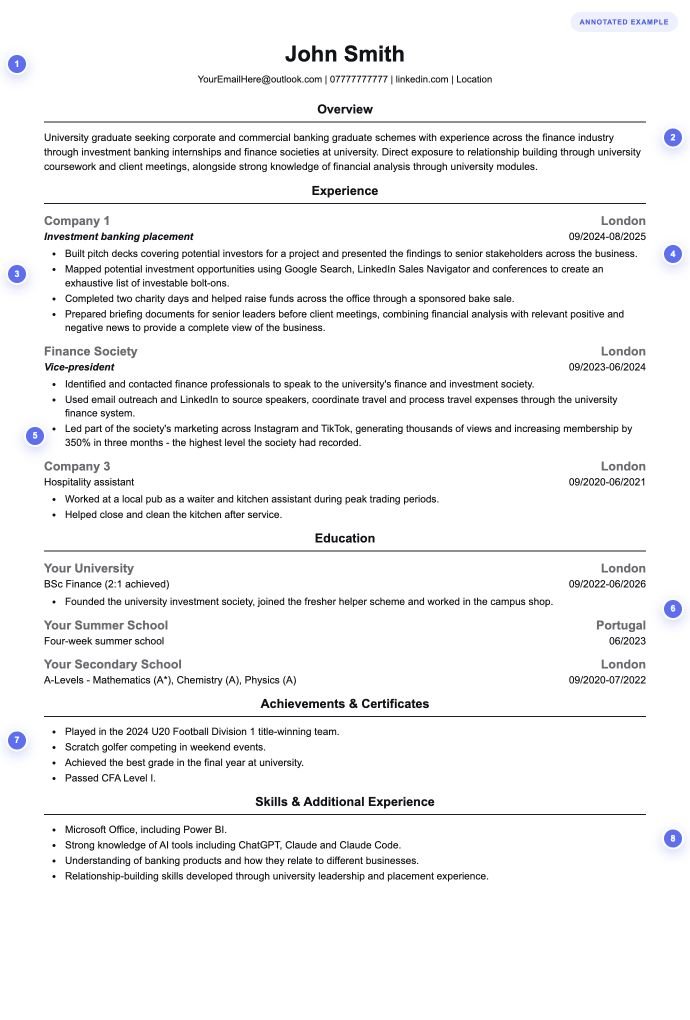
John Smith
YourEmailHere@outlook.com | 07777777777 | linkedin.com | Location
Overview
University graduate seeking corporate and commercial banking graduate schemes with experience across the finance industry through investment banking internships and finance societies at university. Direct exposure to relationship building through university coursework and client meetings, alongside strong knowledge of financial analysis through university modules.
Experience
- 4 Built pitch decks covering potential investors for a project and presented the findings to senior stakeholders across the business.
- Mapped potential investment opportunities using Google Search, LinkedIn Sales Navigator and conferences to create an exhaustive list of investable bolt-ons.
- Completed two charity days and helped raise funds across the office through a sponsored bake sale.
- Prepared briefing documents for senior leaders before client meetings, combining financial analysis with relevant positive and negative news to provide a complete view of the business.
- Identified and contacted finance professionals to speak to the university's finance and investment society.
- Used email outreach and LinkedIn to source speakers, coordinate travel and process travel expenses through the university finance system.
- 5 Led part of the society's marketing across Instagram and TikTok, generating thousands of views and increasing membership by 350% in three months - the highest level the society had recorded.
- Worked at a local pub as a waiter and kitchen assistant during peak trading periods.
- Helped close and clean the kitchen after service.
Education
- Founded the university investment society, joined the fresher helper scheme and worked in the campus shop.
Achievements & Certificates
- Played in the 2024 U20 Football Division 1 title-winning team.
- Scratch golfer competing in weekend events.
- Achieved the best grade in the final year at university.
- Passed CFA Level I.
Skills & Additional Experience
- Microsoft Office, including Power BI.
- Strong knowledge of AI tools including ChatGPT, Claude and Claude Code.
- Understanding of banking products and how they relate to different businesses.
- Relationship-building skills developed through university leadership and placement experience.
Use this as a structure, not a script. Every claim on your own CV should be specific, accurate and backed by evidence you can discuss at interview.
What banks assess
What should a commercial banking CV demonstrate?
A generic graduate CV lists experience. A strong commercial banking CV explains why that experience is relevant to clients, lending decisions and responsible commercial judgement.
Recruiters are not expecting a final-year student to arrive as a trained relationship manager or credit analyst. They are looking for evidence that you can learn the work and operate credibly around clients, financial information and risk.
The weighting changes by programme. A relationship-management route may care more about communication and customer understanding; a financing or credit-focused route may place more weight on analysis, accuracy and evidence-based recommendations; a transaction-banking or product route may value process improvement, technology and understanding how businesses manage cash.
Analytical ability
Show where you examined data, financial statements, survey results, company performance or industry information and reached a conclusion. Useful evidence includes identifying a margin decline, comparing competitors, checking assumptions, building an Excel analysis or summarising risks for someone else. Do not write “strong analytical skills” without showing the task, your contribution and the decision or output that followed.
Commercial awareness
Demonstrate that you understand how a business generates revenue, manages costs, serves customers and funds growth. For UK corporate and commercial banking, relevant themes include working capital, interest costs, foreign-exchange exposure, supply-chain pressure, sector conditions and the difference between profitable growth and cash generation. You do not need a separate news section; embed commercial thinking into the evidence you present.
Communication and relationships
Relationship teams need people who can prepare properly, listen, ask sensible questions and explain information without hiding behind jargon. Use customer-service work, presentations, committee roles, mentoring, client meetings or group projects to show how you adapted your communication, resolved an issue or built trust with people who had different priorities.
Judgement and responsibility
Banking work involves controls, confidential information and decisions that can affect clients and the bank. Show where you checked work, escalated a problem, protected sensitive data, balanced speed with accuracy or took ownership of a deadline. A modest example handled responsibly is stronger than an inflated claim about “leading strategy”.
Lloyds Banking Group
Its current graduate pages distinguish Business and Commercial Banking from Corporate Banking and Markets. A CV for the former should normally foreground business customers, relationships and practical problem-solving; the latter can justify greater emphasis on larger companies, products, markets and more complex financing needs. See Lloyds’ programme comparison →
NatWest Group
NatWest currently advertises a two-year Commercial Banking graduate programme and describes the area around helping businesses grow. Candidates should make client understanding, analysis and practical decision-making easy to find. See NatWest Commercial Banking →
Barclays UK Corporate Bank
Barclays describes work with major UK strategic clients and needs ranging from everyday banking to complex transactions and ESG planning. Evidence of industry research, stakeholder communication and structured problem-solving is therefore more useful than generic enthusiasm for finance. See Barclays UK Corporate Bank →
Barclays International Corporate Bank
The programme covers products including lending, trade finance, cash management, liquidity, digital banking and hedging. Applicants should avoid pretending to know every product and instead prove they can learn technical material, understand client needs and communicate accurately. See Barclays International Corporate Bank →
Recommended structure
How to structure a commercial banking CV
For most final-year students, the strongest format is simple, chronological and easy to scan. Every section should help the recruiter decide whether to move you forward.
UK graduate recruiters are used to plain, evidence-led CVs. LSE Careers recommends clear bullet points and notes that UK employers do not typically expect a photograph. One page is a sensible starting point for a student with limited experience; use a second page only when it contains genuinely relevant evidence rather than stretched spacing or repetition.
Use a readable font, consistent dates and standard section headings. The CV may pass through recruitment software, but it will also be read by people. A conventional layout helps both. Avoid tables with complex merged cells, ratings out of five, logos, headshots and text boxes that force the reader to work out the order.
Contact details
Include your full name, mobile number, professional email address, LinkedIn profile and a general location such as London, Manchester or Edinburgh. A full street address, photograph, date of birth, marital status and nationality are not normally required on a UK graduate CV. Right-to-work questions are usually handled separately in the application form.
Personal profile—optional
Use a profile only when it adds a clear argument: the area you are targeting, the strongest evidence you bring and why it is relevant. “Motivated finance student with excellent communication skills” wastes space. A useful profile might connect a finance degree, client-facing employment and company-analysis experience to corporate and commercial banking.
Education
List your university, degree, dates and expected or achieved classification clearly. If the scheme specifies a 2:1, make the expected result easy to verify; NatWest currently states a 2:1 requirement for its Commercial Banking programme, while requirements differ elsewhere. Add selected modules, dissertations or projects only when they provide evidence such as financial-statement analysis, economics, data work or company research. Include A-levels concisely where employers request them or where they strengthen the application.
Work experience
Use reverse chronological order and normally two to four bullets per role. Put the most relevant evidence first, even when the job was not in banking. A supermarket, hospitality or call-centre role can prove customer judgement, resilience and accuracy; an internship can demonstrate research, meeting preparation or stakeholder exposure. Explain what you did, how you approached it and what changed or was delivered.
Leadership and extracurricular activity
Use finance societies, sports, volunteering, student funds and committee roles to show initiative, responsibility and communication. “Member of Finance Society” adds little. “Researched UK bank earnings and presented the findings to 30 members” gives the recruiter evidence. Include budgets, event attendance, fundraising totals or membership growth only when the figures are accurate and you can explain your contribution.
Skills and interests
Keep this section short and specific. Technical skills might include Excel functions you have actually used, PowerPoint, Power BI, Python, financial-statement analysis or another language. Avoid visual skill bars and broad claims such as “advanced Excel” unless you can define them. Interests should be genuine and concrete enough to discuss naturally in an interview.
Length, file format and filename
One page is usually enough for a final-year student; do not exceed two pages unless the employer asks for more. Save the final document as a PDF after checking that headings, bullets and dates have not moved. Use a professional filename such as Alex-Morgan-Commercial-Banking-CV.pdf, not CV-final-v8-new.pdf.
No banking internship?
How to write a commercial banking CV without banking experience
Graduate schemes are designed to develop people. Your job is not to disguise the absence of banking experience; it is to translate the experience you do have into credible evidence.
Retail, hospitality and customer service
Show how you handled difficult queries, prioritised during busy periods, followed cash or stock procedures and communicated with customers. These examples can support relationship-management applications when they are written as evidence rather than generic claims.
University projects and coursework
Use projects involving financial statements, economics, statistics, business strategy or industry research. Name the question you investigated, the analysis you performed and the recommendation or presentation produced. A relevant project is stronger than a long list of module titles.
Societies, sport and volunteering
These activities can prove leadership, discipline, teamwork and ownership. Give the scale: budget managed, people coordinated, events delivered, funds raised or frequency of commitment. Avoid claiming that every sports activity automatically demonstrates leadership.
Independent commercial research
You can strengthen a thin CV by completing a real piece of work: compare two UK banks, analyse a listed company’s results, study the working-capital cycle of a retailer or explain how higher interest rates affect a leveraged business. Publish or present the output only when it is accurate and genuinely yours.
Writing stronger evidence
Weak and improved commercial banking CV bullet points
Better bullets do not need invented numbers or exaggerated outcomes. They need enough context for the recruiter to understand what you actually contributed.
A useful bullet usually contains four ingredients: a clear action, the task or problem, the scale or method and the output. Lead with the information most relevant to the banking role. For example, “prepared briefing notes” becomes more valuable when the reader can see that you researched a company, selected material information and produced something used in a client meeting.
Use plain English. Internal acronyms from an internship may mean nothing outside that employer, while inflated verbs such as “spearheaded” or “transformed” can sound implausible when the evidence is junior. Strong wording should make the contribution clearer, not larger than it was.
Weak
Helped customers and worked as part of a team.
Improved
Resolved customer queries during peak trading periods, prioritising competing requests and communicating clearly with customers and colleagues.
Weak
Analysed a company for a university project.
Improved
Analysed the financial performance and competitive position of a UK-listed retailer, identifying margin pressure and presenting recommendations to a four-person project panel.
Weak
Treasurer of the Finance Society.
Improved
Managed the society’s annual budget, introduced monthly cash-flow reporting and presented spending recommendations to the committee.
Weak
Prepared documents for meetings.
Improved
Prepared briefing notes for weekly client meetings by summarising company performance, recent news and outstanding actions for the relationship team.
Using AI responsibly
How to use AI when writing a commercial banking CV
AI can improve clarity and reveal weak evidence. It becomes dangerous when it invents achievements, exaggerates responsibility or produces language you cannot defend in an interview.
Use AI after you have written an evidence inventory in your own words. Start with the real task, who was involved, the tools used, the difficulty, your exact contribution and the outcome. Then ask the tool to improve structure without changing the facts.
Do not paste client names, unpublished financial information, internal credit papers, customer data or confidential employer documents into a public AI tool. Replace sensitive details with neutral descriptions and check your employer’s policy before using any work material.
Good uses of AI
- Shortening long sentences without changing the facts
- Finding vague or repeated language
- Comparing your evidence with a job description
- Checking grammar, dates and formatting consistency
- Asking questions that expose missing evidence
- Testing whether a bullet is understandable to a non-specialist
Bad uses of AI
- Inventing numbers, responsibilities or outcomes
- Adding banking knowledge you do not possess
- Uploading confidential employer or client information
- Copying generic language without rewriting it
- Stuffing the CV with every word from the job advert
- Submitting the first generated version
Common mistakes
What weakens a commercial banking graduate CV?
Most weak CVs are not ruined by one dramatic error. They lose credibility through generic language, poor prioritisation and claims that do not match the evidence.
A common mistake is using an investment-banking-style CV without adapting it. Corporate and commercial banking still value analysis, but the role also involves customers, lending judgement, products, controls and long-term relationships. A document that talks only about valuation models and deals can miss the actual requirements.
Another mistake is writing for an imagined algorithm rather than a recruiter. Use the employer’s terminology where it is accurate, but do not repeat “commercial awareness”, “relationship management” and “credit analysis” in every section. The evidence should carry the keyword.
- Listing duties without proving how you performed them
- Using generic claims such as “excellent communicator”
- Focusing entirely on technical finance and ignoring clients
- Writing dense paragraphs that are difficult to scan
- Claiming modelling, credit or accounting skills you cannot defend
- Using skill bars, graphics and unnecessary decorative elements
- Sending exactly the same CV to every banking programme
- Adding fake metrics merely to make a bullet sound stronger
- Using unexplained abbreviations or internal company jargon
- Leaving inconsistent dates, punctuation or spacing
- Copying a personal profile that could belong to any graduate
- Putting the least relevant experience first because it is the longest
- Failing to distinguish your contribution from the wider team’s work
- Saving the document in an unprofessional or confusing filename
Free download
Download the Commercial Banking CV Template Pack
Receive the editable Word template, completed graduate example, annotated CV and final submission checklist by email. The pack is built for UK applications to programmes such as Lloyds Business and Commercial Banking, NatWest Commercial Banking, Barclays Corporate Bank and comparable corporate or institutional banking routes.
- Designed for UK corporate and commercial banking applications
- Simple one-page structure that can expand to two pages when justified
- Editable sections for education, experience, leadership and skills
- Examples showing how to translate non-banking experience
- A checklist covering evidence, formatting, tailoring and AI accuracy
Find open corporate and commercial banking schemes
Use the live FinancePathway tracker to compare current application status, deadlines, regional locations, published starting salaries and official employer links. Check the programme wording before tailoring the CV because commercial, corporate, relationship and transaction-banking routes can assess different evidence.
→Prepare for the rest of the recruitment process
A strong CV may get you through the first screen, but it will not answer interview questions for you. Learn how commercial banking works, how banks think about businesses and lending, and how to prepare for video interviews and assessment centres.
→Frequently asked questions
Commercial banking CV FAQs
What should a commercial banking CV include?
Should a graduate banking CV be one or two pages?
Do I need previous banking experience?
Can I use this as a corporate banking CV template?
Should I include a personal profile?
Should I include a photograph, full address or date of birth?
Will banks reject an overdesigned CV?
Can I use AI to write my CV?
Current UK programme and CV references
This guide uses current programme terminology from Lloyds Banking Group, NatWest Group, Barclays UK Corporate Bank and Barclays International Corporate Bank, alongside HSBC’s programme finder. General UK CV conventions are informed by the National Careers Service and LSE Careers. Employer requirements change, so applicants should always check the live vacancy before submitting.